
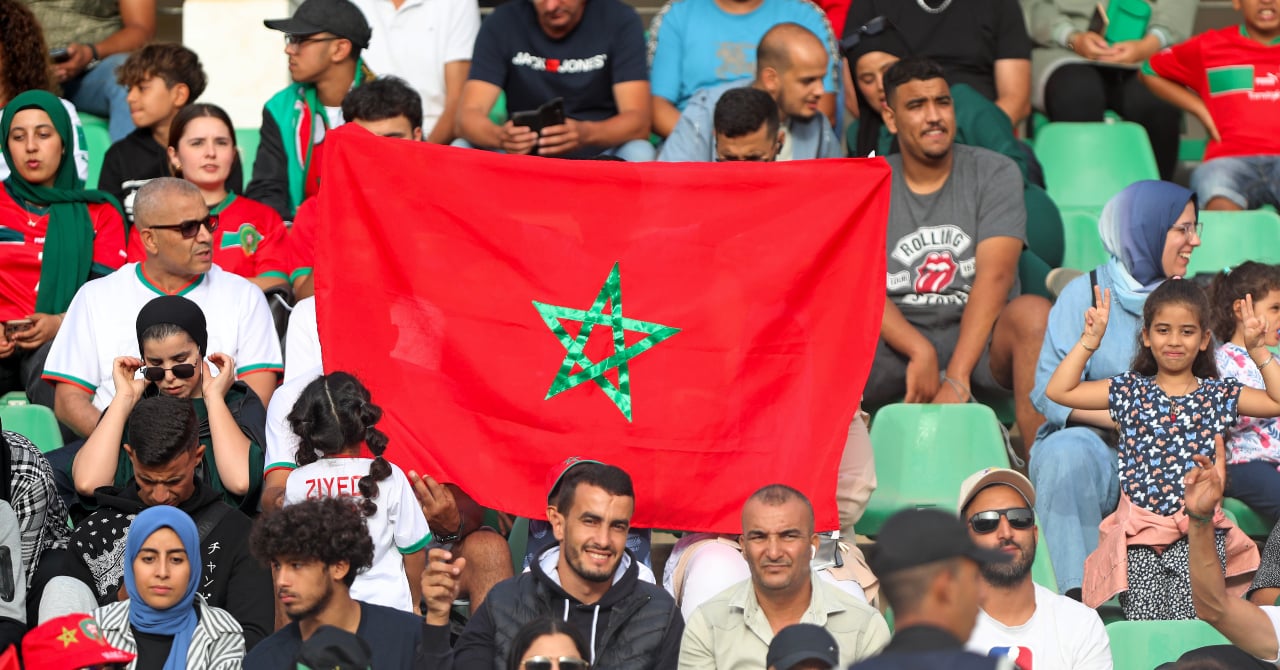
For several days, Morocco has been crossed by a wave of events of unprecedented magnitude. In Rabat, Casablanca, Marrakech or Agadir, thousands of young people descend into the street to denounce the degradation of public services and claim urgent reforms in the fields of health and education. Born on social networks, the collective “Genz 212” has become the megaphone of exasperated youth, demanding more equality and dignity. But in this tense social climate, a symbol particularly crystallizes anger: the African Cup of Nations, scheduled for December 21, 2025 to January 18, 2026 on Moroccan soil.
A CAN at the heart of popular anger in Morocco
The gap between the colossal investments made for the organization of the competition and the social distress of the country nourishes the dispute. While nearly 900 million euros were hired for the renovation of six stadiums and nearly 470 million for the construction of the large stadium in Casablanca, the slogans hostile to the CAN multiply in the processions: “The stadiums are ready, but where are hospitals?” ». Some Moroccan internationals such as Nayef Aguerd or Sofyan Amrabat have publicly expressed their solidarity with the demonstrators, while the main group of Atlas Lions supporters announced a boycott of the next matches of the national team.
The climbing of tensions worsened after the death of two demonstrators during a confrontation with the police in Leqliaa, raising fears of a radicalization of the movement. The CAF, for the time being silent closely, follows the evolution of the situation. It has already postponed the opening of the first ticketing phase, officially for logistical reasons. In parallel, Morocco has introduced new visa restrictions for supporters in certain countries, a sign of growing concern in terms of security. So many clues that leave an uncertainty around the good performance of competition in the country.
Previous that feeds speculations
The history of African football is not unrelated to the last -minute relocations. In 2015, Morocco itself had given up hosting the CAN due to the Ebola epidemic, forcing the CAF to transfer the event to Equatorial Guinea. Other precedents exist: Libya in 2013 and 2017 due to civil war, or Kenya in 1996 for infrastructure reasons. On the planetary level, we also remember that the 1986 World Cup had had to be reassigned to Mexico after the withdrawal of Colombia. These examples recall that, faced with major security or political crises, the bodies do not hesitate to change the plan.
If calls for boycott, violence and proximity to the deadline represent serious alert signals, a relocation at this stage would pose considerable logistical and financial challenges. The infrastructure is ready, huge investments, and no alternative country has positioned itself to host competition as short as possible. The Moroccan government promises to listen to social demands and respond to them “Positively”but the evolution of the protest in the coming weeks will be decisive. So, will the CAN 2025 be maintained in Morocco? The answer remains, for the moment, suspended on the street.
