
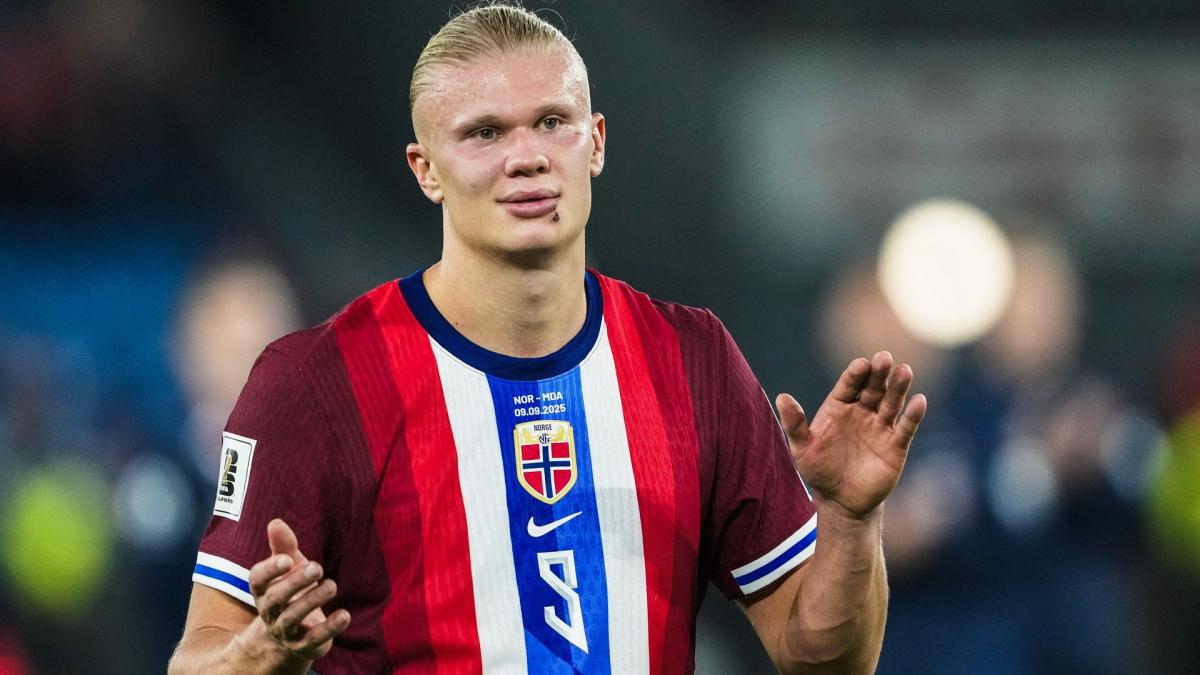
Group I of the 2026 World Cup is already shaping up to be one of the toughest groups of the tournament. Alongside the French team, Senegal and Norway will form a trio of formidable opponents, while the intercontinental play-off has designated Iraq as the fourth nation in the group. With this mix of favorites and outsiders, each meeting promises to be interesting and above all revealing for the future. The Blues will have to prepare for a demanding schedule and confrontations against teams of very different profiles, with Norway appearing as one of the most impressive on paper, without a doubt.
Senegal, which had two convincing victories against Peru (2-0) and Gambia (3-1), does not hide its admiration for the Norwegian selection. At a press conference, coach Pape Thiaw stressed: “I think it’s a great team. For me, at the moment, it is even the best European team. She is showing very good things, even if she lost her last match without her two stars (2-1 defeat against the Netherlands, editor’s note). » These comments immediately put pressure on all the opponents in Group I and show that Norway is seen as a real threat by its peers, more simply as a team dependent on Erling Haaland. Faced with these adversaries with very different profiles, France will absolutely have to maintain and even increase its growing power.
Norway, a formidable offensive machine
Norway are undoubtedly one of the most formidable teams in Europe today. Before its narrow defeat against the Netherlands (2-1), it remained undefeated since… October 2024, with an impressive series in qualifying. Erling Haaland, the main star of this team, has 55 goals in 49 caps and finished top scorer in qualifying for the 2026 World Cup with 16 goals in just 8 matches. Didier Deschamps recognized this on M6: “Norway had a very high level qualifying campaign, scoring a lot of goals. She has a lot of qualities, athletic as well. They were the best team in pot 3, that proves the quality of this opponent”. These figures reflect Norway’s phenomenal offensive capacity, capable of putting any defense in difficulty, especially physically.
The team led by Ståle Solbakken has several dangerous profiles. Up front, Haaland and Sorloth, both over 1.90 m, generate permanent danger on crosses and in the area. Their compactness and duo play allow for frequent second balls and repeated striking situations. Even when Haaland has been rested or absent, players like Jørgen Strand Larsen have shown they can maintain the attacking threat. The Norwegians also exploit high pressing and rapid transitions, making the opposing defense vulnerable in the event of losing the ball. Which could represent a real danger for the Blues, even if Saliba and Upamecano have impressive recovery qualities.
However, signs of fragility are appearing. After the defeat against the Netherlands (2-1), Norway was also held in check by Switzerland (0-0) during another friendly match at the last meeting in March. Despite a compact block and the tenure of Haaland, the team lacked fluidity in decisive areas and came up against a rather well-organized opponent. These mixed performances, combined with the absence of some key players like Ødegaard, show that the Norwegian selection is not invincible either and can be countered by a well-prepared team.
A disappointing March rally on the Norwegian side
France, for its part, displays a very reassuring dynamic. The Blues dominated their opponents during the last friendly matches in March, successively beating Brazil (1-2) and Colombia (1-3). This success is accompanied by the construction of a solid collective, with automatisms which are created and cohesion which is affirmed between the players. This gathering allowed Didier Deschamps to lay the foundations of a confident and above all well-organized group, capable of responding to the physical and tactical challenges proposed by Norway.
Tactically, the Blues have arguments to counter Norwegian assets. The speed and creativity of Kylian Mbappé, Michael Olise and Ousmane Dembélé, combined with the defensive solidity and versatility of the squad, offer several solutions to limit the repeated crosses and the aerial presence of the Scandinavians. Quick transitions and collective work around the midfield strengthen the team’s ability to contain opposing attacks, while maintaining options to score on the counterattack. For his part, Erling Haaland declared after the draw via a story on his Snapchat account, with a sober message: “France and Senegal will be formidable adversaries”.
Clearly, the question of whether France should really fear Norway remains nuanced and will depend on several factors… The Scandinavians impress with their offensive power and the presence of Erling Haaland, but their recent performances reveal certain limits. Before facing the Blues on June 26, Norway will have a final crucial preparation meeting against Sweden on June 1, which will constitute a major test to assess their state of fitness and fine-tune certain details. The Blues, on the strength of their recent victories, will approach this confrontation with confidence despite everything, while remaining aware that Norway can be formidable.
