
If there is one thing that FC Barcelona supporters and managers are proud of, it is La Masia. The Barcelona training center continues to produce great talent, and against Real Madrid on Sunday evening, many players from the academy will start the match and play a major role in this clash which is exciting the planet. A certain contrast with what is happening with the Merengues, since no player trained at La Fabrica should appear in José Mourinho’s starting eleven. Some also ironically note that with Marc Cucurella, there could be more players trained at FC Barcelona than players trained at Real Madrid in the Madrid team which will start the match.
On the Catalan side, we do not hesitate to highlight this contrast between cantera y cartera – training against wallet – to highlight the fact that the Madrilenians prefer to recruit rather than give a chance to young people from the center. An observation which is also shared by many Madrilenians, who watch what is happening with a certain desire. The very meager presence of Real Madrid players in the last groups of the selection also hurt the capital, seeing how FC Barcelona but also other clubs like Real Sociedad or Athletic sent more players to La Roja than them. Is the Madrid training center so bad?
Two different models
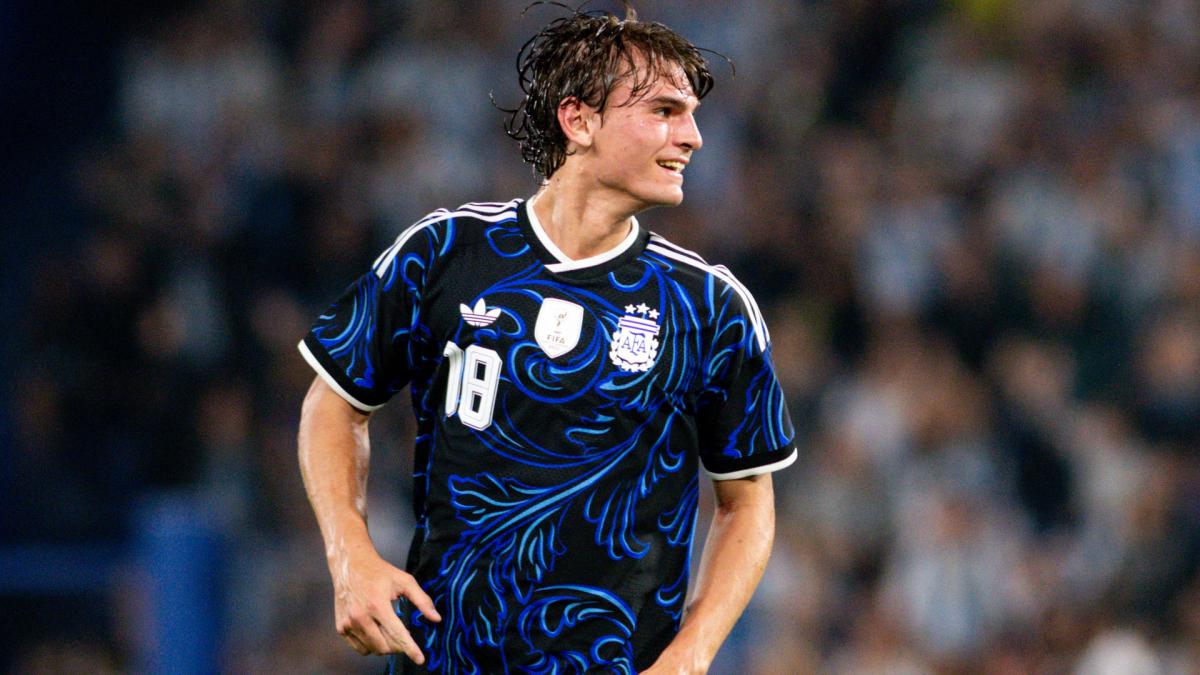
Clearly not. Quite the contrary: Real Madrid also has one of the best training centers on the planet. An analysis of the CIES published earlier this week even reveals that Real Madrid is the club which has trained the most players playing in a European big 5 club: 40 in total, compared to 34 for FC Barcelona. They are also those who have the most playing time on average. Proof that the players who trained in Madrid are elite players. At the moment, players like Jacobo Ramon and Nico Paz (Como), Achraf Hakimi (PSG), Marcos Llorente (Atlético), Chema Andrés (Brighton) or Mario Gila (AC Milan) are doing well away from Castellana, while the first steps of players like Víctor Muñoz (Liverpool) or Gonzalo Garcia (Fulham) in the Premier League are also convincing.
In recent years, the club from the Spanish capital even seems to have reached a milestone in terms of talent production. Why do such talented players, who for some are on par with those trained by FC Barcelona, not play for Real Madrid? It’s a question of philosophy, with Real Madrid generally having rather short-term projects, and too regular changes, where FC Barcelona seeks stability, and even when there are changes of coaches, the model remains the same. In the Madrid context, it is difficult to launch young people, since they are asked to perform well from the start, in a media and social context that is generally less friendly towards young people than in Barcelona. It should be noted that Real Madrid’s B team plays in D3, while that of FC Barcelona plays in D4, further proof that even if La Fabrica does not produce generational talents like Lamine Yamal, the quality of the average player trained in Madrid is just as good as that of La Masia.
Barça also draws inspiration from Real Madrid
Where the big difference is significant is that Real Madrid mainly uses its training center to replenish the coffers. This summer, the Merengues collected around 200 million euros, between players trained at the club sold and the sale of players trained at La Fabrica who already played elsewhere, but on whom Real Madrid still retained rights. Indeed, for years already, and aware of the potential of local players, Madrid decision-makers have decided to keep 50% of the rights of the players they sold. Just to ensure a check by selling them, then receive another one in the future. Potentially very juicy. The example of Víctor Muñoz is particularly striking. In the summer of 2025, Real Madrid sold him to Osasuna for 5 million euros. A year later, Osasuna sold him to Liverpool for 40 million euros, and the Whites therefore recovered 20 million euros in this deal.
FC Barcelona recently started using this process. Before, and even if certain players had left for 50% of the rights like Oscar Mingueza, Barça generally contented themselves with a buyout option to be able to, potentially, bring the player back. Last summer, the Cadena SER indicated that from now on, Barça would retain half of the rights of any player trained at home. Jofre Torrents was thus sold to Ajax for 5 million euros, and Barça will receive half of a possible resale. So, even if La Masia is perhaps the great world reference in terms of training,
