
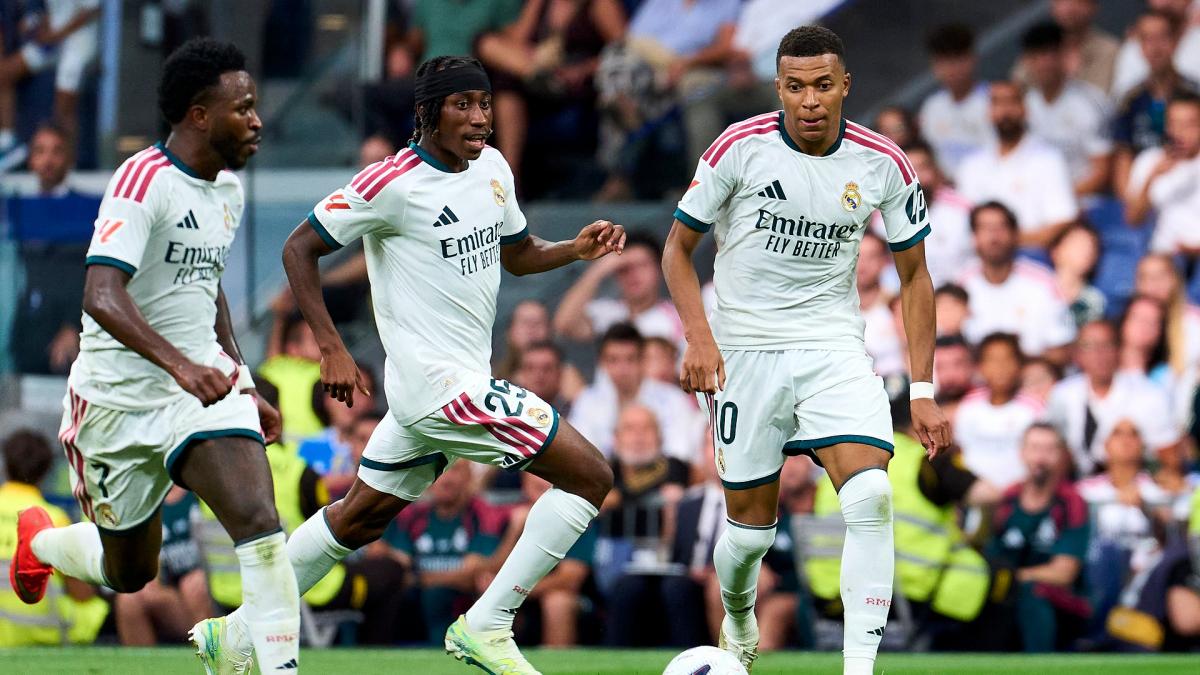
A few years ago, both FC Barcelona and Real Madrid greatly appreciated the French market. Certain players like Aurélien Tchouameni, Eduardo Camavinga or Ferland Mendy are still present in Madrid, while in the 2010s, the Catalan club also enlisted several French players or players playing in Ligue 1. But in recent years, the trend has clearly faded, and if we put aside the market opportunity Ibrahima Konaté or Kylian Mbappé, it is rare to see the two Spanish ogres take an interest in the French market. Of course, there is no doubt that if the possibility of recruiting Michael Olise presented itself, FC Barcelona and especially Real Madrid would jump at it. But it is obvious that in recent years, the two La Liga leaders have turned their backs on French football.
This is not necessarily a talent pool problem, since France continues to produce quality players. First possible explanation: the latest experiences are not really conclusive and therefore do not necessarily invite the two clubs to continue to dig into France. At FC Barcelona, the French and/or Ligue 1 players recently recruited have not been completely satisfactory, on different scales. Malcom, Jean-Clair Todibo, Ousmane Dembélé, Clément Lenglet, Antoine Griezmann and Jules Koundé have some had good moments, but the results are generally bad. At Real Madrid, a similar observation for the players who preceded Karim Benzema or Raphaël Varane. The leaders of the two clubs have therefore perhaps been cooled…
Football has changed
Another explanation, and it is perhaps a little more down to earth than the first: the appearance of new players, and therefore new competitors, on the market. With the appearance of Saudi clubs, and increasingly powerful English clubs, the number of clubs capable of competing with FC Barcelona and Real Madrid has increased considerably. If there could be four or five clubs including Real and Barça on the same player at one time, today there can be around ten. And inevitably this causes colossal inflation in player prices. In 2016, Samuel Umtiti cost FC Barcelona only 25 million euros. Ten years later, there is no doubt that it would have cost at least double.
And it is also valid in the other direction: the power of these new purchasing clubs makes it very complicated to snatch players from them afterwards. FC Barcelona, for example, tried to acquire Eli Junior Kroupi this summer, but Bournemouth demanded a minimum of 100 million euros. A completely prohibitive amount, which Barça cannot or does not want to pay, but which English big names could align themselves with without shaking their chins too much. It must also be said that the recruitment policy of the two clubs has changed: now, we are trying to recruit young players for “correct” sums before they explode and become the stars of tomorrow, a bit like Barça did with Bisiwu or Abdelkarim this summer, and like Real Madrid has been doing for a while too. And players playing in France are already too expensive.
Internal changes
In the case of Barça, we are also obliged to mention this financial crisis which calmed the club’s enthusiasm in the transfer window and which pushed the management to turn, more than was already the case, towards its training center. The decrease in French or Ligue 1 players in the two La Liga giants can also be explained by structural changes. Both, for example, had French managers or advisors internally. Éric Abidal was technical secretary of Barça at the end of the 2010s, and his predecessor, Robert Fernandez, was also an expert in Ligue 1, where he wanted, for example, to enlist Jean Michael Seri. On the Madrid side, Zinédine Zidane, whether as an advisor to Florentino Pérez or as a coach, has also pushed to explore the French market.
Today, Deco and his right-hand man Bojan Krkić, as well as Hansi Flick who also has his say, are not particularly focused on France. At Real Madrid, where Juni Calafat is the main instigator of the transfer windows. Coaches also have decision-making power, although they are not always respected by the hierarchy. The French market is no longer very popular. Calafat is thus more turned towards America, while José Angel Sanchez, general director of the club, is more fond of trying shots in big European clubs. The French are therefore no longer necessarily popular in Spain… until an interesting opportunity presents itself! In the meantime, it’s time for the Clasico!
