
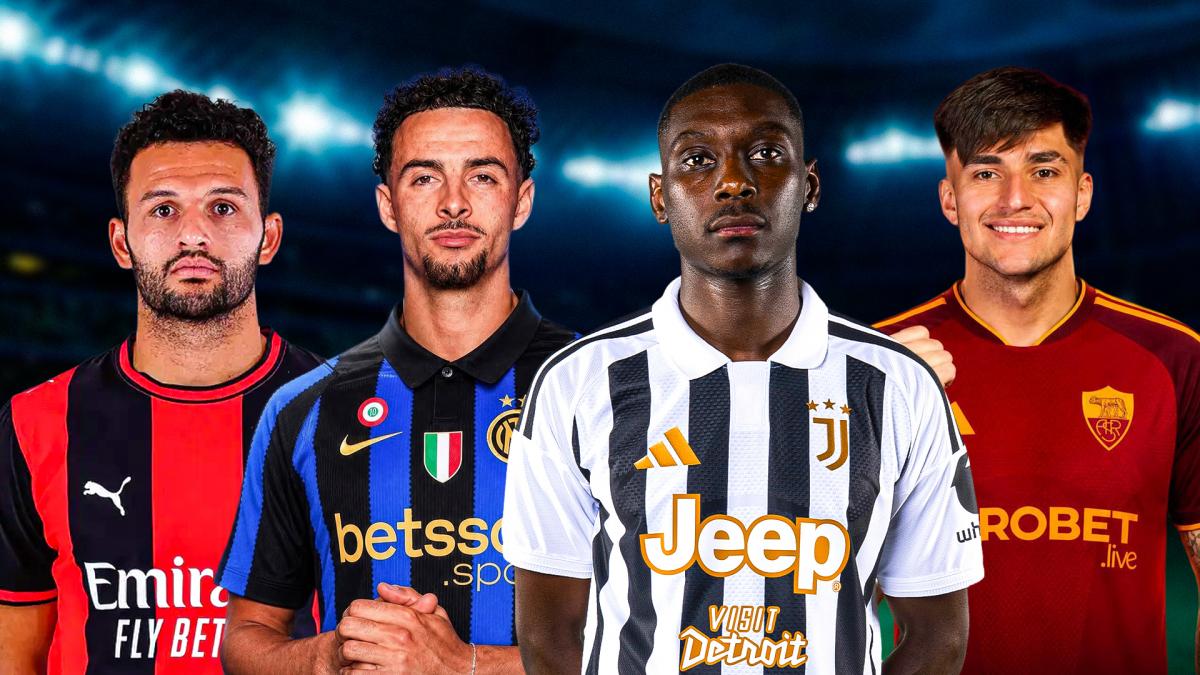
The summer transfer window has closed its doors and Serie A has hit hard on the transfer market. Italian clubs have invested around 1.20 billion euros to strengthen their workforce, confirming a trend that has now been well established for several years. The figure is slightly lower than the 1.23 billion spent in the summer of 2025, but remains significantly higher than the amounts recorded at the start of the decade. Serie A had thus devoted 962.7 million euros to transfers during the 2022/2023 financial year, before climbing to 977 million in 2023/2024, then crossing the symbolic billion mark for the first time with 1.19 billion in 2024/2025. The following season, the Italian championship accelerated further with 1.23 billion, before stabilizing around 1.20 billion this summer.
At first glance, the dynamic seems relatively regular, with investments remaining at a particularly high level. But behind this stability lies a major difference which considerably changes the reading of the Italian market. Serie A clubs sold much less this summer, with only 739 million euros in revenue, compared to around 1.11 billion during the previous transfer window. In other words, Italian football continued to spend massively while recovering much less money through transfers. It is precisely this imbalance which gives this summer window a particular dimension and explains why this 1.2 billion raid deserves to be looked at more closely.
Six clubs with +100 million expenses
This frenzy is not based on a single heavyweight, but on a fairly broad mobilization of the main teams in the championship. AC Milan spent 165 million euros, including the arrivals of Gonçalo Ramos for 74 million and Diego Moreira for 50 million, while Juventus invested more than 160 million, driven in particular by the recruitments of Randal Kolo Muani at 41.20 million and Kerim Alajbegovic at 32 million. Napoli also showed its ambitions with around 150 million euros spent, including 44 million for the activated option of Rasmus Højlund, while AS Roma spent around 125 million on its recruitment, notably with Santiago Castro for 36 million, Donyell Malen for 25 million and Rodrigo Mora for the same sum. Fiorentina was also particularly active with nearly 150 million euros committed, spread over a large number of operations, while Inter exceeded 100 million with in particular Curtis Jones for 30 million, Djed Spence for 30 million and Aleksandar Stankovic for 23 million. Even teams less accustomed to appearing in the top places in the spending ranking participated in this acceleration, like Como, capable of spending 30 million on Trevoh Chalobah and nearly 40 million for the paying loan of Moise Kean. The Italian market was not simply driven by one or two locomotives, but was driven by several historic clubs wishing to strengthen their squad at the same time, with a common desire to immediately gain in competitiveness.
Behind this spectacular accumulation of expenses, there is first of all a very clear sporting desire to put the Italian championship back in the forefront. Transalpine clubs are coming out of several seasons during which they regularly had to deal with significant economic constraints, favoring free players, loans, low-cost operations or recruitments financed by significant sales. This summer also marks a form of change in philosophy carried by the new president of the federation Giovanni Malagò, as well as the government of Giorgia Meloni. AC Milan, Juventus, Napoli, Roma and Inter are seeking to build squads capable of playing leading roles in Italy, but also of having more influence on the European scene. The investments made in players like Ramos, Højlund, Kolo Muani and Moreira reflect this desire to focus on profiles capable of having an immediate impact or retaining significant value in the coming years. The logic is that of an investment intended to produce sporting results, which must then make it possible to increase revenues via European qualifications since Italy has seven European clubs including four in the Champions League.
A new policy for 2032
Added to this is another fundamental element which goes far beyond the simple transfer window. Calcio prepares a profound transformation of its environment. Stadium modernization projects are increasing and the twenty Serie A clubs have initiated projects to renovate or transform their enclosures. Italy has especially accelerated its program with a view to Euro 2032, which it will organize with Turkey. Thirteen Italian cities have submitted applications for sixteen stadiums to the FIGC this summer, with only five venues ultimately being selected for the tournament. The new Roma stadium in Pietralata, the projects around Milan, the renovation of the Franchi in Florence, the planned work at the Maradona in Naples and the new Bologna stadium project illustrate this change. In Florence, the municipality confirmed in July its commitment to continue the renovation of the Franchi as part of the candidacy for Euro 2032, while Naples obtained the administrative green light for its project to modernize the Maradona. Italian football is seeking to take advantage of this period to restore the image of calcio before 2032, with the ambition of having more competitive clubs, modernized infrastructure and a more attractive international image.
Euro 2032 acts as a powerful accelerator, since the five Italian stadiums selected must meet UEFA’s requirements and be ready early enough to host the competition. The FIGC received applications from thirteen cities, from Bari to Turin via Milan, Rome, Naples, Florence, Bologna and Cagliari, a sign of the scale of the work underway in the country. The Italian government also estimates the investments that can be mobilized around sports infrastructure at several billion euros, while the authorities want to accelerate several projects from the end of this year or the beginning of next. And this is how spending on the transfer market takes on another dimension. Clubs no longer just want to survive economically or limit their losses, they seek to regain an attractiveness capable of retaining more talent, attracting top players, increasing commercial revenues and allowing Italian teams to once again become regulars in the last European rounds. Serie A has agreed to take more risks to accelerate this reconstruction. It remains to be seen whether this spectacular raid will be the start of a truly new cycle for calcio or simply the symptom of a one-off desire to return to the top.
