
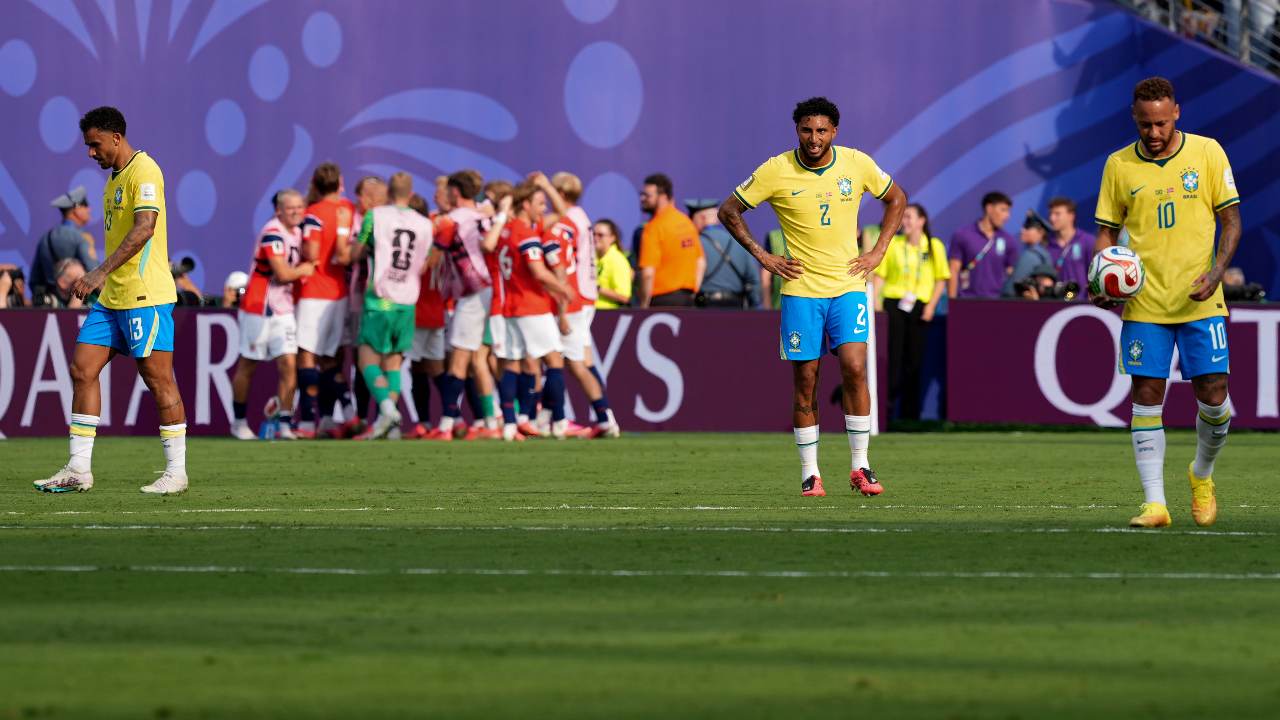
The trauma is total and is reminiscent of that of 2014. The day after the historic elimination of the Seleção in the round of 16 of the 2026 World Cup against Norway (1-2) at MetLife Stadium, Brazil woke up with a huge hangover. Twenty-four years after its last coronation in 2002, the “country of football” equals its longest period of drought in the history of the World Cup. And unsurprisingly, the Brazilian press is showing rare violence with its players and its coach Carlo Ancelotti.
Globo Esporte: “Complacency and mental wreckage”
The largest sports portal in the country, Globo Esporte, opens its pages with a clinical and merciless observation. For the media, this fiasco is not an accident, but the logical consequence of chronic instability which has lasted for four years. The famous analyst Rodrigo Coutinho took no gloves to dissect the attitude of the players on the pitch.
“Complacency and lack of precision were the main factors in Brazil’s elimination from the competition. Facing a team as rigorous as Norway, the Seleção played with guilty complacency, forgetting that a World Cup round of 16 requires sweat, not just golden passports. »
The site also recalls terrifying figures which illustrate the drift of the Brazilian Football Confederation (CBF) since Qatar: four different coaches and 96 players tested in a four-year cycle. An artistic blur that paid off in the face of Scandinavian pragmatism.
The trial of Carlo Ancelotti
For the sports daily Lance!, this elimination sounds the death knell for the European illusion. The arrival of Carlo Ancelotti, supposed to bring the tactical rigor that was so lacking in local technicians, is today described as an industrial failure. In a vitriolic editorial, the newspaper criticizes the total lack of fundamentals of a team incapable of creating danger without relying on sterile individual exploits.
“Brazil left through the back door, without its own style and deprived of tempting cracks. We sold our soul for a “modern” European tactical project which ended up sanitizing our football. Under the leadership of Ancelotti, the Seleção played monotonous, predictable football, completely devoid of that spark of creativity that once shook the planet. »
The newspaper also points out the Italian technician’s inability to react on his bench when Erling Haaland began to impose his physical law on the Brazilian defense.
For its part, UOL focused its analysis on the ordeal of the Brazilian central hinge, totally helpless in the face of the double blow from the Norwegian cyborg. “Haaland dominates, and Brazil collapses, he notes bitterly. The observation is terrible but fair: today, the king of world football is not dressed in yellow and green. Norway, with its simple but sharp weapons, exposed the structural weaknesses of a Brazilian team which no longer knows how to defend as a unit and which panics as soon as the physical level rises. »
UOL also emphasizes the psychological gulf that separates this generation from the great teams of the past, describing players “paratified by the stakes from the opening of the Norwegian score”.
The tragic twilight of the Neymar generation
The ESPN Brasil channel focused at length on the end-of-match images, in particular the close-ups of Neymar, in tears, sitting on the Philadelphia pitch. Despite his penalty scored at the very end of the match, the number 10 is the symbol of a glorious era on paper, but sterile in reality.
The channel’s consultants did not hide their immense weariness. “Neymar’s tears are those of a twilight. It is the end of an era which ends without the slightest additional star on the jersey, they lamented. It was long believed that his genius would be enough to mask collective deficiencies, but modern football has definitely taken over. Seeing Brazil come up against a European wall for the sixth consecutive time in the final phase is a humiliation which must push for a total reconstruction. »
“A national mourning”
As for general newspapers like O Globo or Folha de Sao Paulo, the titles evoke a “national mourning” and one
“historical shame”. The press highlights the now gaping divide between the supporters and a team made up of stars exiled in Europe, considered too disconnected from reality and the popular fervor of the country.
The watchword in Rio as in São Paulo is now the same: razing everything, from the CBF offices to the technical staff, to rebuild its own identity before the 2030 World Cup.
