
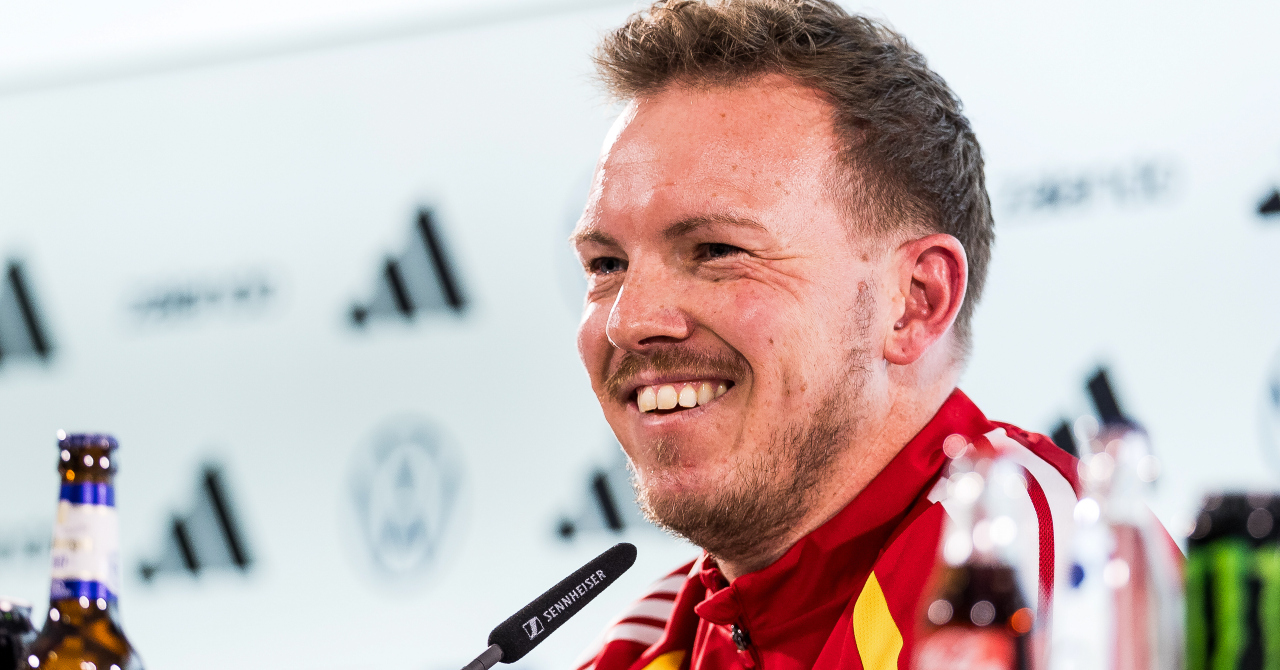
Julian Nagelsmann is right. Totally, absolutely right. When the German coach reacted to Ibrahim Maza’s choice to represent Algeria, he said some words that felt good:
“The national team has nothing to do with where I would be more likely to play. It’s about whether I’m proud to represent the country. I have to feel it. » Everything is said. A national selection is not a club. You don’t choose a country like you choose an employer on LinkedIn, by comparing career opportunities on an Excel sheet. We choose it with the heart, with the guts, with this feeling of belonging that cannot be negotiated.
Sports pragmatism against the ideal
Maza’s justification, pointing out the fierce competition from Musiala and Wirtz, comes from an implacable sporting logic. But it is precisely this logic that Nagelsmann refuses to apply to a nation. Some will say the coach is naive, his words “outdated” at a time when football is a profession before being a game. That may be true. But hearing a coach defend this romantic vision is refreshing. He reminds us that a homeland can be defended even from the bench, because the anthem that sounds tightens the throat and the jersey weighs heavier than any other.
Let’s not blame Ibrahim Maza for all that. He is 19 years old, has a disarming sincerity, and comments which, according to several sources, have been poorly translated. His attachment to his Algerian origins is deep and legitimate. Either. But Nagelsmann’s message goes beyond himself. Because what
“squeaks”, is to hear a player, whoever he is, publicly explain that he chooses a country because there will be “more chances to play”. This reduces selection to a simple calculation of opportunity. And Nagelsmann reminds him that it is bigger, stronger, more intimate than that.
More than bitterness, a principle
We can certainly detect a hint of frustration in the coach’s output. The technical director of the young Germans came in person to try to retain the player, without success. But reducing this statement to bitterness would be a mistake. Nagelsmann doesn’t just talk to Maza; he speaks to all these binational players who weigh the pros and cons, look at the FIFA rankings, or evaluate the probability of playing in a World Cup before making their choice. He refuses this pragmatism which transforms patriotism into a career strategy.
Maza will learn to communicate better. He is young, honest, and his talent speaks for itself. But Nagelsmann’s words will remain. Because they remind us of a simple truth: when we feel like we belong to a country, we are ready to wait, to fight to climb the hierarchy. We don’t calculate, we feel. In an increasingly sanitized, mercantile and calculating football, hearing a coach talk about “heart” and “emotions” is not naivety. It is a necessity to protect the very essence of national football.
