
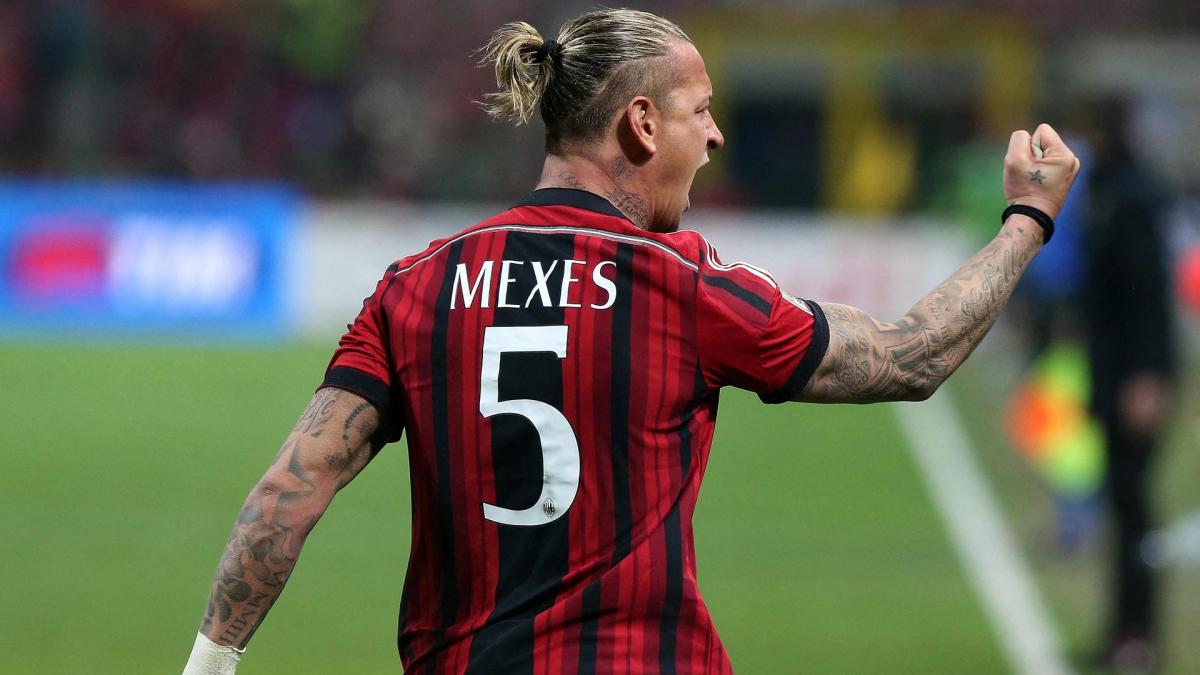
After ten years away from the world of football, Philippe Mexès is preparing to return to Ligue 1 with a microphone in hand. The former defender of AJ Auxerre, AS Roma, AC Milan and the French team joins League 1+ for this new adventure, alongside Adil Rami in particular. A reconversion which was not necessarily expected, but which responds to a new desire for the former French international, who remained away from the media tumult for a long time after hanging up his boots. Buoyed by the experience of a podcast which allowed him to gradually emerge from his comfort and rediscover a taste for the collective, Mexès finally agreed to dive back into a universe that he knows intimately, but which he will now observe from the other side of the line. More reserved than his new partner on set, he intends above all to remain himself and bring a perspective nourished by nearly twenty years of career at the highest level. Before returning to the Ligue 1 pitches in a different costume, he tells us behind the scenes of this surprising reconversion, his new duo with Rami, but also his uncompromising view of Italian football, its infrastructure and above all the persistent shortcomings of the transalpine team.
“I’m not going to play a role, I’m going to stay myself”
French Football Weekly: Philippe, how did this choice come about to become a consultant for Ligue 1+? We didn’t necessarily expect it, you are undoubtedly one of the most surprising recruits of this new team. How did this happen behind the scenes?
Philippe Mexes: I just felt like it was the right time. It’s been ten years since I stopped my career and, since then, I have devoted a lot of time to my family and my children. I wanted to enjoy them, to spend time with them. Then I did the podcast with Smaïl, and it opened my mind a little. It took me out of my comfort at home and allowed me to rediscover a little of this collective spirit, this group and family atmosphere that I had known in football. Then, I was asked to come on Sunday evening, notably with Adil Rami. I was told he would be on set and asked if I would be interested in participating. I answered why not. I am a very sincere person and I said to myself that with the experience I had internally, with the joys, the sadness and all the daily life of a locker room, I could perhaps contribute something with an outside perspective. If I can do my bit and give some good information to the public, that’s the most important thing.
FM: Do you still have a little apprehension before launching into this new role?
PM: I’m not really afraid. And then there is Adil, so he will also have some responsibility. He is more extroverted and he knows more about the subject today. Me, I’m a little more reserved and shy, but I will still have my say if I can provide a look or some information. It’s mainly up to me to inform myself and get back into the swing of things. It was precisely an opportunity to return to Ligue 1 after twenty years.
FM: How do you imagine your duo with Adil Rami? You have been teammates, but you have also experienced competition. Have you ever discussed how you operate?
PM: we are not going to play a role. We’re going to stay ourselves. I think that’s the most important thing. We played together, we know each other very well. We experienced a lot of pressure together, particularly with the France team and in Milan. There was also competition between us, obviously, but it remained friendly. Today, Adil knows the players better and is more up to date with current events. I need to get back to it, but I’m going to do it seriously because it’s becoming more and more interesting.
FM: What made you want to return to Ligue 1, after being away from football for ten years?
PM: I watch a few matches and I see that there is a lot of young talent. It interests me enormously. I wanted to rediscover this atmosphere, this championship atmosphere that I knew. Ligue 1 is very instructive and I have the feeling that it is progressing.
FM: So you want to take the time to discover this new generation and look at it?
PM: yes, completely. I have to get back into the news, watch the players, the teams, follow the evolution of the championship. This is also what I like about this new experience. I will be able to rediscover Ligue 1 with a different perspective from the one I had when I was a player.
FM: could this experience as a consultant lead you to consider other projects in football, or even one day a role as coach or sports director?
PM: not at the moment. I could actually have started something a long time ago, since it’s been ten years since I stopped my career. But my priority was my family, raising my children, educating them and spending time with them. Now that they are grown up, I want to rediscover certain sensations, particularly those of the collective and exchanges with former teammates. And the Ligue 1+ project really seemed interesting to me. They have full Ligue 1 rights and I thought it was a real opportunity. I said to myself why not. It’s a new experience for me and I want to live it to the fullest.
FM: after ten years away from professional football, what are you looking for today in this new adventure?
PM: I think that I especially want to find this world without necessarily finding the constraints of the player. I experienced the joys, the difficulties, the pressure and the daily life of a locker room. Today, I can look at all of this with a little more perspective and pass on what I have learned. That’s what interests me about this role.
“Italy’s big flaw today is that it does not invest enough in training”
FM: you spent most of your career in Italy. When you look at Serie A today, what is your view on the evolution of Italian football?
PM: When I arrived in Italy, I discovered a Serie A which was coming out of a very complicated period, notably with the Calciopoli scandal. Little by little, the championship rose in everyone’s esteem. At the time, there were the best players in the world. I played against Recoba, Adriano… It was incredible. The list of phenomena and great players present in Serie A was impressive. The fact of having evolved with and against these players allowed me to progress very quickly. Today, Italian football remains fun to watch and Serie A remains Serie A. Milan has built a very big team, Roma too. Afterwards, it is true that there are difficulties, particularly on the economic level and in terms of infrastructure.
FM: Italian stadiums are often singled out for their dilapidated state. In your opinion, is this one of the main obstacles to the development of Serie A?
PM: clearly. I think it would take a big event, like a World Cup or something similar (Italy will co-host Euro 2032 with Turkey, editor’s note), to push for a major renovation of the infrastructure. Today, it is complicated for everyone economically, not just for Italy or France. But Italian football retains something special. It remains attractive and competitive. Italian clubs continue to perform well on the European scene. It’s just a shame that Serie A is less followed in France than the Premier League or La Liga.
FM: exactly, you mention the economic difficulties. Do you think that Italy has fallen behind in certain areas compared to other major European championships?
PM: necessarily. There was a period when Italy was truly at the top of European and world football. Today, certain countries have invested more in infrastructure, training or even the economic development of clubs. Italy must regain this capacity to invest to once again become a benchmark in the long term.
FM: another subject comes up regularly, that of training. Young Italian teams are achieving very good results, but clubs often continue to recruit foreign players rather than launching their young players. How do you explain it?
PM: This is something I never really understood. When I arrived in Italy, coming from the Auxerre training center, it was one of the first things I noticed. There wasn’t really the same culture at the training center as in France. In France, at 16 or 17 years old, a young person can gradually integrate the professional group, be on the bench, be the seventeenth player, be on a match sheet. Even if he doesn’t play, this proximity to professionals gives him confidence and allows him to gradually discover the high level. In Italy, we often prefer to loan youngsters to Serie B or the lower divisions so that they gain experience. But sometimes it’s a waste of time. The player travels a lot, moves, changes environment regularly. This is not necessarily the best way to support him in his development.
FM: why, in your opinion, has France been more successful in creating this culture of training?
PM: because in France, we have long understood that the training center was the base. Whether in Lyon, Auxerre, Nantes, Monaco or elsewhere, you have structures that allow young people to work and progress in a professional environment. If you want to build a future for your national football, the first thing to do is to invest in training. Italy has very good young people, that’s exactly what’s a shame. The potential is there, but we need to give them more opportunities.
FM: can the very strong media pressure in Italy also explain this difficulty in launching young people?
PM: in Italy it’s different. There are a lot of newspapers, radios, media. A young player can very quickly find himself under pressure. If he is a little sensitive to all this, he can quickly suffer mentally and psychologically. I think a young Italian feels a lot more pressure than a young Frenchman. This is also why we need to better support him and allow him to progress in an environment where he can gain confidence.
FM: you have kept many links with Italy and in particular with Roma. Do you stay close to certain people at the club?
PM: When I go back, I really feel like I’m at home. I kept in touch with a lot of people. Francesco Totti, Daniele De Rossi… I notably went to Trigoria to see Daniele when he was Roma coach. With some, it’s as if we had left each other the day before. That’s what’s magnificent. They are still very good friends. Afterwards, everyone went about their lives. Daniele chose to become a coach, Francesco enjoys his family more today and has decided to eat well too (laughs, editor’s note). He’s always been a bon vivant.
FM: When you return to Rome, do you still feel this special relationship with the supporters and the club?
PM: I spent a lot of years there and experienced a lot of things. These are memories that remain. Even if your career is over, the connections you created don’t disappear. This is also why returning to Rome is always special for me.
FM: If you had to identify the main project in Italian football today, would it be training?
PM: for me, the big fault in Italy today is that it does not invest enough in training. And that’s precisely what’s paradoxical because they have super young people. The problem is that we now have to give them the means to become the players they can be.
