
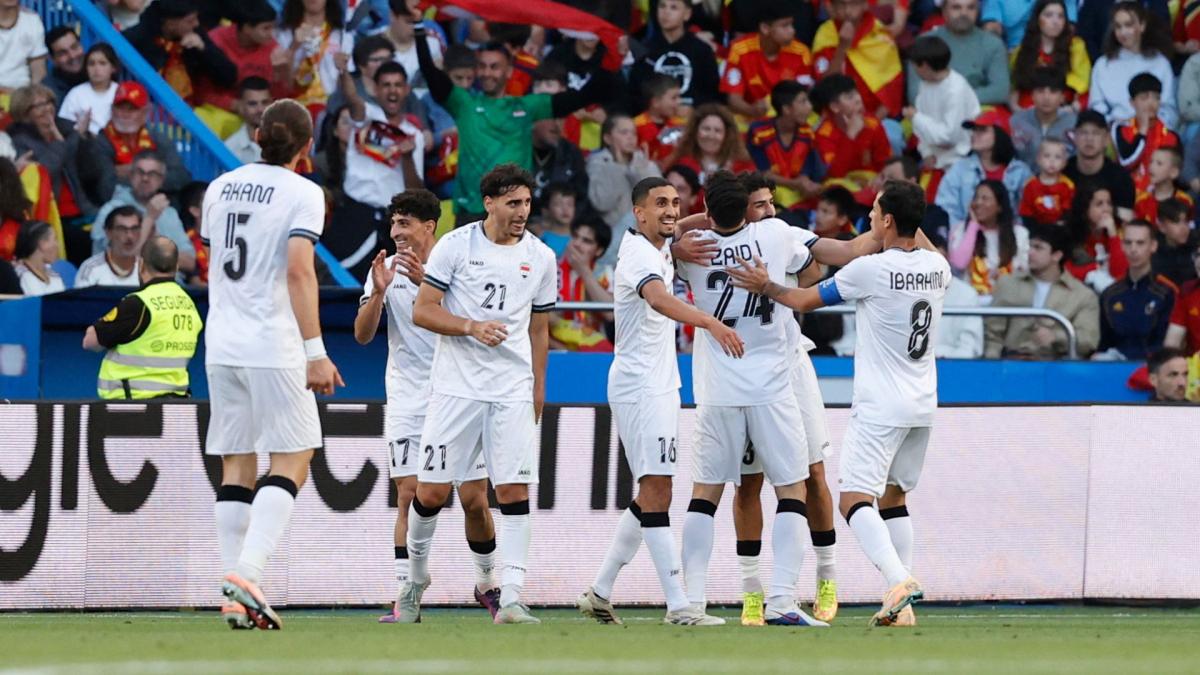
On March 31, in Guadalajara, Mexico, Iraq became the 48th and final country qualified for the 2026 World Cup. A 2-1 victory against Bolivia sealed the ticket and millions of jubilant Iraqis throughout the country. The scene of Graham Arnold, Iraq coach, unfurling an Iraqi flag in the Mexican stands went around the world. It was the Lions of Mesopotamia’s first World Cup qualification since 1986, 40 years ago. “The players had enormous pressure on their shoulders, coming from 46 million people in Iraq, and probably 10 million Iraqis outside the country,” the Australian coach told AFP. The entire country has been waiting for this moment for four decades. And now that he’s here, Iraq isn’t coming just to participate.
Iraq is placed in Group I against France, Norway and Senegal, probably the most difficult group for a team in Group 4. And Graham Arnold had no illusions at the time of the draw. “If you were to go through the value of each player, we would probably be the lowest rated team at this World Cup. But it’s a World Cup. Our guys are fighters. Will we be as technically good as them? No. Tactically, I would say we will be good. Physically, we’re working on it.” Of the 26 players selected, the majority play in the Iraqi championship. But there are elements which have acquired a real European background. Ali Al-Hamadi, the first Iraqi to play minutes in the Premier League with Ipswich, now at Luton Town, is the offensive spearhead, decisive scorer against Bolivia. Behind him, Zidane Iqbal, trained at Manchester United and now at Utrecht, brings his vision of the game and his technique. Merchas Doski (Viktoria Plzen), Amir Al-Ammari (Krakow), Kevin Yakob (Aarhus), Hussein Ali (Pogon Szczecin) complete this Euro-Iraqi core.
A squad designed to be annoying, with talent in Europe
It is precisely this perfect mix that has been the strength of Arnold’s training in recent months. The 62-year-old coach has built a compact block, physical and difficult to maneuver, around a disciplined defensive line. And this approach has already proven itself in preparation. Thursday, against reigning European champion Spain, certainly with a largely reshuffled eleven, Lamine Yamal, Pedri, Rodri and Nico Williams left to rest, Iraq held a 1-1 draw. Ferran Torres opened the scoring on the counter-attack (16th), but Merchas Doski surprised Joan Garcia with a magnificent fleeing cross which ended up in the back of the net. Luis de la Fuente did not mince his words after the meeting. “All the matches are very difficult but Iraq is clearly a very intense, fast and dynamic team. She also knew very well how to develop a collective game based on combinations. I found it very interesting and above all very unpredictable and very intense. Today they gave us a lot of problems and put enormous pressure on us.” Before that, Iraq had beaten Andorra 1-0 and is preparing to play Venezuela in the United States before its first World Cup match against Norway on June 17.
France will face Iraq on June 22 in the second group match. If the Blues did the job against Senegal, it will theoretically be a qualifying match. But in a World Cup expanded to 48 teams, where the game accelerates and where tactically prepared outsiders can do very badly, nothing is taken for granted. Even more so with the best third-place finishers who can qualify. Graham Arnold had already surprised more than him. In 2022, he led Australia to the round of 16 in 2022 in Qatar. In the French group that he knows very well, he managed to dominate Tunisia and Denmark had to lose at the last minute against the World Champions (1-2). “Shock the world”Arnold told his players after qualifying in Guadalajara. For France, the message is probably worth a warning.
