
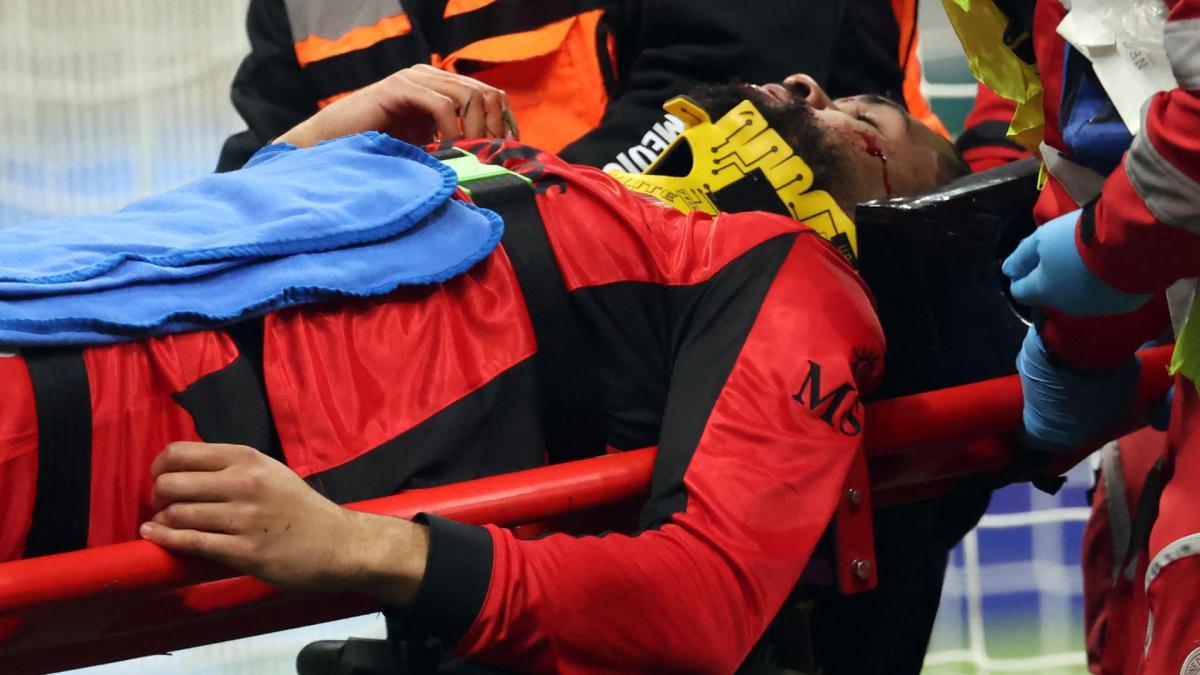
The new controversy which is shaking Italy started from a chilling scene and an arbitration decision which stunned even the most neutral observers. During AC Milan’s defeat against Parma at San Siro, everything changed in the 8th minute when Ruben Loftus-Cheek attacked the area with an outstretched cross. The English midfielder gets ahead of the defense, the goalkeeper comes out at full speed… and the collision is of rare violence. The shock is frontal, uncontrolled, brutal. The medical intervention did not take long, and the images of the ex-Chelsea player being taken out on a stretcher, with a bloody face, broken teeth and a neck brace, still remain shocking for some of the fans and players present at the stadium. The diagnosis then comes like a blow: Ruben Loftus-Cheek suffers from a broken jaw and will be operated on at the start of the week. Unable to feed himself, he will probably have to have metal plates installed. And yet, the decision of the Italian referees remains astonishing: no foul called, no penalty, no red card.
Worse still, the fault is ultimately attributed… to Ruben Loftus-Cheek. An interpretation which instantly set the Milan bench, the stands and social networks ablaze, relaunching an already burning debate on the state of refereeing in Serie A. This scandal does not fall from the sky and comes after an already explosive week since the very controversial Italia derby between Inter and Juventus. As a reminder, referee Federico La Penna had sent off Pierre Kalulu after two warnings, the second of which, for slight contact with Alessandro Bastoni, was judged imaginary by numerous slow motions. The first card had already been considered severe after a duel with Nicolo Barella. The decision, impossible to correct by VAR because it was linked to a second yellow, changed the match and sparked a national storm. Italian football woke up the next day with the impression that the spectacle had been confiscated by the whistle. This climate of generalized suspicion forms the direct background of the Loftus-Cheek case, which now appears to be one episode too many.
A real scandal
The Rossoneri expressed their incomprehension and anger on the pitch. The validation of Troilo’s goal in the 80th minute, initially refused by Piccinini for contact between Valenti and Maignan, then confirmed after video viewing, reinforced the feeling of injustice. The frustration of players and coaches with these refereeing decisions reveals a deleterious climate, where player safety and sporting fairness seem relegated to the background. In this already tense context, the action involving Loftus-Cheek is seen not as a simple error, but as confirmation of a structural malaise. The repetition of controversial decisions gives the impression of a system running out of steam, incapable of protecting players or guaranteeing sporting fairness. Milan’s situation is worsening sportingly and psychologically. After this defeat (0-1) at home, the Rossoneri saw Inter widen the gap to 10 points at the top of the standings, reducing their Scudetto hopes to almost nothing against Inter.
But this Milan defeat and this now significant gap in the ranking would matter almost less than the storm caused by the refereeing. The frustration was visible even among the stars, notably Rafael Leão, furious after the late validation of the opponent’s goal and silent in front of the referees. The Loftus-Cheek affair could also accelerate the discussions planned for February 28 by IFAB on the extension of the VAR protocol to second yellow cards, precisely the type of action at the heart of recent controversies. In the meantime, the image sent back is disastrous for a championship where we talk more about refereeing decisions than about the game, where serious injuries no longer even result in sanctions, and where every weekend seems to produce its scandal. In Italy, the series of recent incidents, from the Milan-Juve derby to the Loftus-Cheek collision, accentuates the feeling that football can no longer be content with following the game, but must finally protect its players and restore the credibility of its decisions.
