
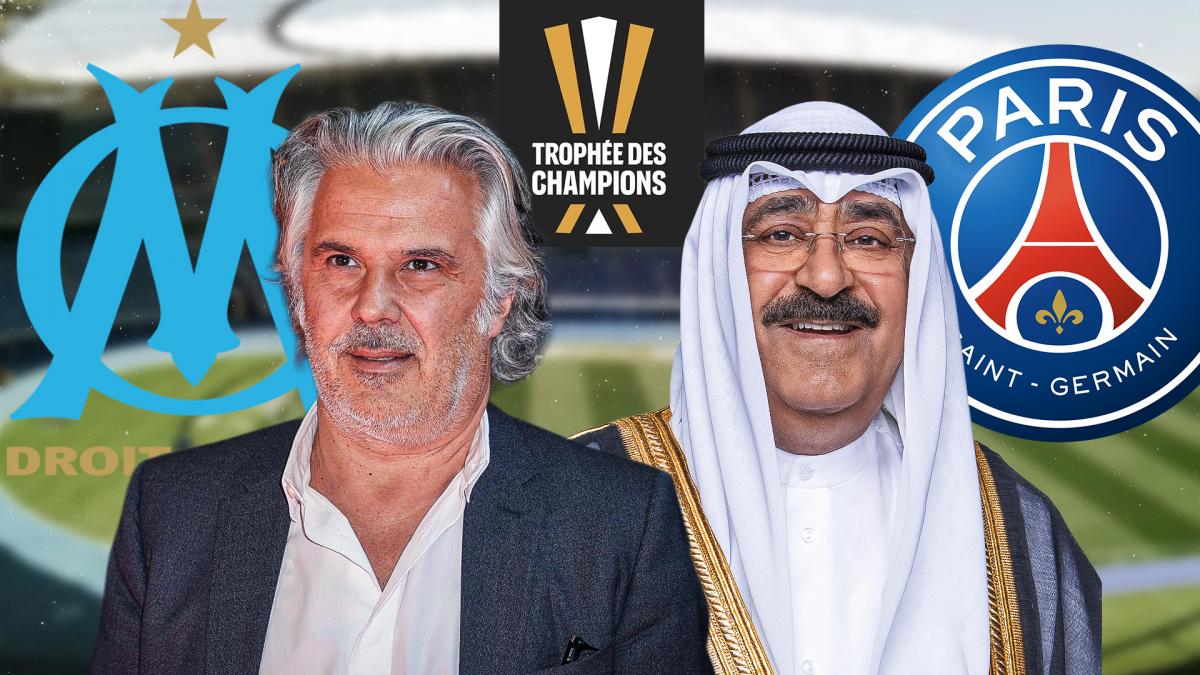
The Professional Football League (LFP) surprised the football world by announcing that the 2026 Champions Trophy between Paris Saint-Germain and Olympique de Marseille will be held at the Jaber Al-Ahmad International Stadium in Kuwait City, a modern venue with nearly 58,000 seats. Accustomed to exporting this poster to China, Canada, Morocco or the United States, the LFP is innovating this time by turning to a country less exposed to the media than its Gulf neighbors such as Qatar or Saudi Arabia. However, this choice is not trivial since it reflects a strategy of opening up to new sporting markets while promoting a country which, despite limited visibility on the international scene, has for several years invested massively in the development of local football and in the training of its young talents.
In Kuwait, football is not just a leisure activity, but a real social glue. From school grounds to neighborhood lawns, it punctuates the daily life of children, adolescents and families. The national passion for this sport is so deep-rooted that the country has decided to make it a lever of cohesion and pride. The Kuwaiti authorities understood that football could be a vector of educational, social and cultural values. It is in this spirit that the State has invested in the construction of modern infrastructure, in the renovation of stadiums and in the establishment of programs dedicated to the development of youth through sport. The choice of the LFP salutes this popular fervor and Kuwait's effort to place football at the heart of its national identity.
A Classic to prove its development
If the choice of Kuwait to host the 2026 Champions Trophy may be surprising, it is part of a rapidly changing sporting and economic context. The country, long discreet on the international football scene, has been striving for several years to modernize its sports ecosystem. The Jaber Al-Ahmad International Stadium in Kuwait City, an ultra-modern venue with nearly 60,000 seats, has already hosted international matches bringing together up to 58,000 spectators, demonstrating real popular enthusiasm. The Kuwait Football Association (KFA) now supervises ten professional clubs within the Premier League and requires each to produce audited financial statements as part of the club licensing required by the AFC, a sign of growing administrative structure, even if these reports rarely remain public. Big clubs like Kuwait SC, Al-Qadsia or Al-Arabi rely on powerful national sponsors, like the telecom operator Zain, partner of the championship, or local banks and holding companies such as KFH or KIPCO. If the exact amounts of contracts and the number of licensees remain difficult to obtain (reflecting financial transparency that is still partial), Kuwait is clearly displaying its desire to attract the attention of the football world.
By banking on its modern infrastructure, solid economic partnerships and passionate youth, the country intends to establish itself as a new center of sports development in the Gulf. One of the pillars of Kuwait's sporting development lies in the creation of a network of youth football academies, true talent incubators. These centers are not limited to the technical learning of the game, as they instill discipline, teamwork, leadership and pressure management. Young people benefit from professional supervision, adapted physical and psychological programs, as well as academic support to reconcile studies and sport. Through consistent government support, private partnerships and international collaborations, Kuwait is patiently building a generation capable of ultimately competing on the regional and global stage. This training ecosystem, inspired by best European and South American practices, illustrates the country's desire to transform its passion into sustainable excellence.
The crucial role of government
The Kuwaiti government is playing a leading role in this revival, financing the construction of sports infrastructure and supporting promising young people through scholarships and scouting programs. But success also relies on synergy with the private sector: many clubs have opened their own academies, recruiting experienced foreign coaches and adopting modern training methods. Sponsors, for their part, inject financial resources which make it possible to equip the academies with cutting-edge technologies and high-level infrastructure. This mixed model, combining public vision, private dynamism and international ambition, creates a solid and innovative ecosystem. Kuwait thus relies on youth as a pillar of social development and on football as an instrument of national prestige.
Hosting the PSG–OM clash is a resounding recognition of the efforts undertaken by Kuwait to make football an engine of transformation. This event will give unprecedented visibility to the country, highlighting its modern infrastructure and its commitment to the training of young people. The 2026 Champions Trophy will therefore not only be a prestigious match, but it will embody the meeting between two philosophies, that of French football focused on international influence, and that of a Kuwait in full sporting ascendance. This choice, bold but coherent, underlines that football is not only a question of performance, but also of vision, identity and development. Through this event, Kuwait proves that it can be much more than a host, but an emerging player in world football.
