
“It's football, it's competition, you have to adapt to this situation. Nothing important, you have to prepare to know how to manage everything that is happening on a field. I am not concerned. It's the high level “. Last Friday, when Paris Saint-Germain had just announced that Marquinhos came to garnish the ranks of the infirmary, Luis Enrique assured that he was absolutely not concerned and that it was simply the vagaries of football. However, it is not forbidden to think that Spaniard was bluffing and that he did not necessarily want to criticize the calendar very busy with his team and especially a World Cup of clubs widely supported by its president, Nasser Al-Khelaïfi.
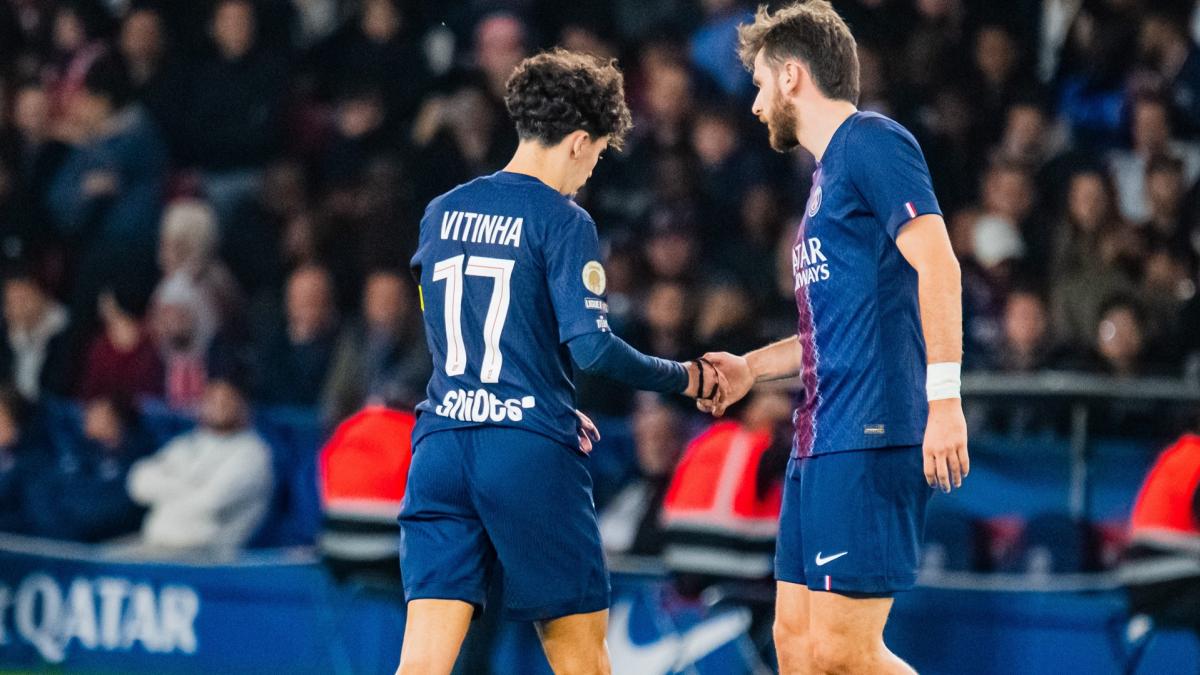
The fact remains that Wednesday evening, Paris risks aligning an eleven departure largely altered against FC Barcelona. Because since the start of the season, the Parisian infirmary has not been full. Ousmane Dembélé, Désiré Doué, Bradley Barcola, João Neves, Fabian Ruiz, Vitinha or Khvicha Kvaratskhelia have all experienced physical seeds. A massacre far from being a surprise. PSG has produced a historic 2024/2025 season by going to the end of all the competitions in which it was engaged. As a result, he completed his exercise on July 13 (final of the club of clubs lost against Chelsea), resumed training on August 6 and had to play his first official match, the European Super Cup against Tottenham, a week later, without real preseason.
Largely respected rest and preparation times
This Monday, the FIFPro (World Player Union) has just published an overwhelming report. “”This report highlights the urgent need for more balanced competition calendars, in parallel with the implementation of minimum regulatory guarantees, protected rest and recovery periods, and a constructive dialogue between decision -makers in the sector. Sustainable solutions are possible if we are committed to a real collaboration and if we give players the place they deserve, that is to say a central place in our reflection. I invite you to think about the conclusions of this report and to join us to set up a football ecosystem which is not only competitive and entertaining, but also responsible, safe and respectful of those who are on the field. Together, we can build a better and more sustainable future for football“Writes the president of the union, Sergio Marchi.
To better understand the signal drawn by FIFPro, it is necessary to stop on some data of this report. Starting with recovery times. The FIFPro recommends a minimum rest period of 28 days after each season. Unsurprisingly, no club having played the Club World Cup could comply with this recommendation. PSG gave its troops 22 days, when Real Madrid and Chelsea gave 20. Then the union recommends that a 28 -day preseason be carried out in order to attack a season with the least risk of injury. Again, the training courses in the new FIFA competition did not respect the situation. PSG had only 7 days of preseason, 13 for Chelsea and 19 for Real Madrid and Manchester City. Even shorter rest and preparation times, while players are overworked. In the top 10 participants in the World Cup club who played the most matches, PSG and Real Madrid are the two teams with the most representatives. (Arda Güler 80 games, Luka Modric 79 Matches, João Neves 76 Matches, Federico Valverde, Fabian Ruiz and Désiré Doué 73 matches).
Young people run a risk
This summer, this competition was also marked by the importance of hot weather. While the United States must co-organize the World Cup in 2026, many players criticize the schedule of matches. “”The heat is incredible. The other day, I was dizzy while playing and I had to lie on the ground. In fact, it is very dangerous to play at that time. It's very dangerous“Said Chelsea Enzo Fernandez. Hence the hypothesis of having meetings of the 2026 World Cup, or even the final, to compete at 9 am local time. Another important factor for recovery: travel times. And for South American players playing in Europe, it's often complicated. The FIFPro announces, for example, that the Ecuadorian Chelsea midfielder, Moisés Caicedo, has traveled no less than 25,000 km to play 4 games in 14 days.
Young people are not spared either. The nuggets of tomorrow are overhanged. The most telling example is that of the player who is considered to be the best player in the world, Lamine Yamal. Returning from the last national rally, the Spaniard had already played 8,158 minutes before celebrating his 18th birthday, almost twice as much playing time as his pursuers, except Madrid Jude Bellingham (6216). “”The growing intensity of modern game is already a challenge for experienced professionals, but for young players aged 16 to 20, the risks are even greater. At a stage where their body and mind are still in development, the constraints of an overloaded calendar and high intensity training can have lasting consequences on the performance and longevity of their careers“Said Doctor Darren Burgess in the report.
