
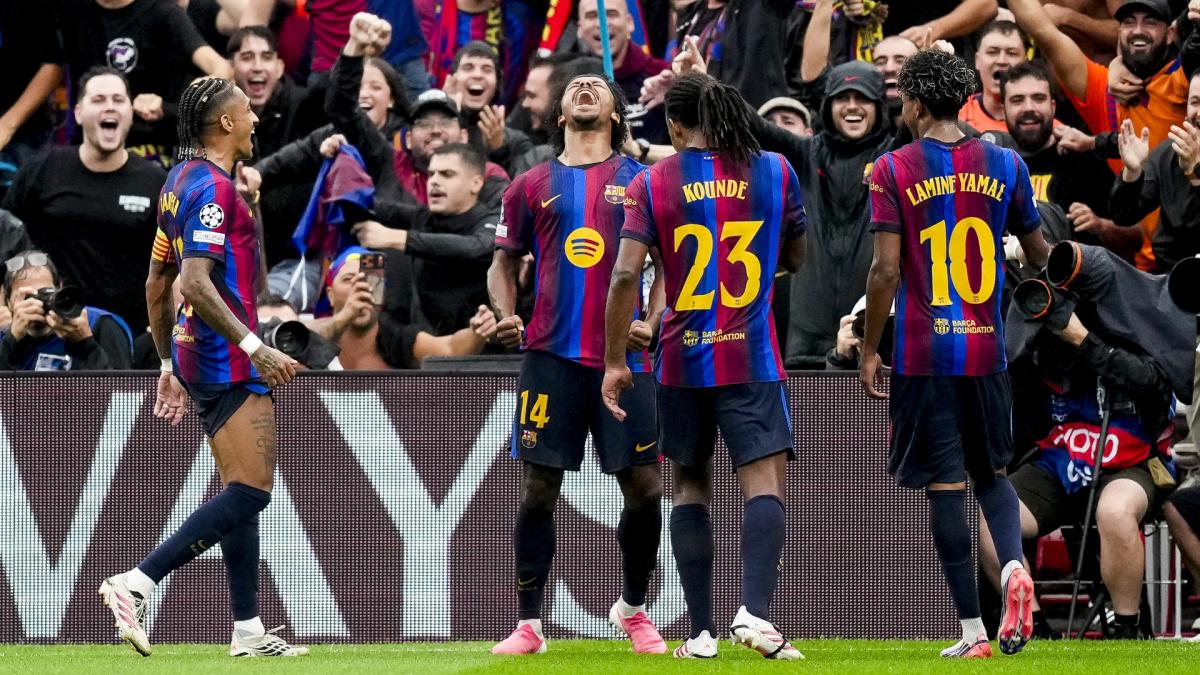
These are perhaps the two best teams in the world who face each other on Tuesday evening, on the lawn of the Parc des Princes. Paris Saint-Germain, double reigning European champion, welcomes a Barça which impresses everyone, with 11 victories in 11 matches and an average of more than 4 goals scored per match. Difficult to choose a favorite… On the other hand, it is interesting to note that many points link the two clubs. The famous comeback, but also Lionel Messi or Neymar, in the past, and a certain rivalry that had taken hold. Luis Enrique, very popular in Barcelona, settled on the Parisian bench, and other players like Ousmane Dembélé, Dro Fernandez and Ferran Torres left Catalonia for the French capital, while relations between the two teams have calmed down a little.
And we know that if the PSG model which aimed to stack the stars was criticized and criticized a few years ago, the new policy put in place by the Luis Enrique – Luis Campos pair is now considered an example of management. To the point where, even on the FC Barcelona side, we want to be inspired by it. And this is also fully assumed, since this summer, the Catalan press explained on several occasions that Deco wanted, on a few points, to emulate PSG. “Look, PSG doesn’t have a real number 9. A classic number 9 conditions the way you play”explained for example the Barcelona sports director this summer, after having made the decision not to recruit any big number 9 to replace Robert Lewandowski.
A similar offensive sector
Certain media thus confirmed that Deco’s objective – with the green light from Hansi Flick – was to have an offensive sector with interchangeable players who could switch constantly, a bit like Luis Enrique’s team. If the construction of each squad is a little different, with the Masia component which necessarily comes into account on the Blaugrana side, we clearly recruit players who correspond to what the coach asks. The media recruits made by management are over, and the sports directors of the two clubs are at the service of their coach, whom they listen to and pamper. Above all, there are a lot of similarities in the way the two teams play, and it’s a safe bet that any PSG starting player could easily repeat his performances if he signed for Barça, and vice versa. Ferran Torres is a good example of this, and the offensive sector is perhaps the best example.
The two coaches require their attackers to be very aggressive in pressing, for the attacking line to be high when recovering the ball and above all, for them to be very mobile and participatory in the game. Out of the question of having a number 9 who camps in the area, or a winger who only runs along the line. The arrival of a player like Anthony Gordon at Barcelona is fully in line with Barça’s desire to continue its evolution, moving closer to what is done at Paris Saint-Germain. Of course, it would be daring to say that Hansi Flick plagiarized Luis Enrique, since he already applied many similar concepts at Bayern, even before the Spaniard arrived in Paris. It must also be said that Luis Enrique is closer to the German school to which Flick belongs than to the Spanish school.
The midfield, the key to the game
The former German selection still seems a little more “kamikaze” than his Iberian counterpart, with a generally higher defensive line, and a little more verticality in the game. But both the German and the Spaniard know that the key to their team’s success lies in the midfield. This is where everything is played out, whether with or without the ball. The qualities of the midfielders of the two formations allow them to alternate between rapid transitions where they try to look very quickly, or phases of control, with longer possessions. Here too, we find many similarities between the profiles of the players lined up in this sector. In addition to all having extraordinary technical and tactical qualities, they are also very complete, and each is capable of playing in front of the defense, as a relay, or even in a more advanced position on the field. João Neves or Pedri are good examples. Other common points should be highlighted, such as the importance of the full-backs in offensive transitions, even if PSG is a little ahead on this side.
PSG has also taken a long lead over its European competitors in other slightly extra-sporting aspects. With Nike and its subsidiary Jordan, the capital club has succeeded in making the club logo a real lifestyle brand, with exclusive clothing lines which are worn in the four corners of the planet, and drops which are real events. With, also, the desire to become more and more self-sufficient and no longer depend on QSI. Even if it started a long way behind the other European leaders in terms of prestige and visibility, Paris has managed to establish itself as one of the leaders, if not the leader, in this lifestyle sector, and Barça is now trying to do the same to increase its income. In recent months, the Catalan club has released new ranges, as well as special collections, in collaboration with Nike and Spotify, such as the GOLF WANG jersey for the Clasico, sold at €500, and various t-shirts and sweaters from the range. Paname influences the world!
