
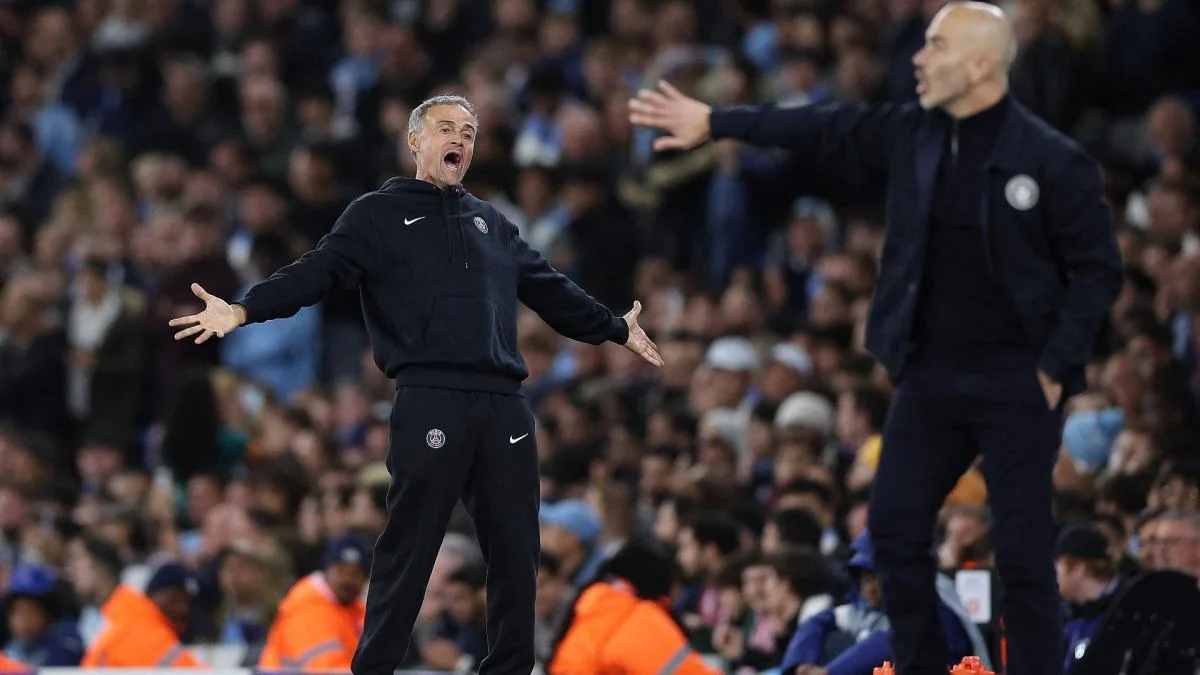
The exit of Enzo Maresca has relaunched a debate which has accompanied Paris Saint-Germain for several years. After the confrontation against Manchester City, the Italian coach highlighted the possibility for the Parisians to give certain players a break during the Ligue 1 matches preceding the major European meetings. “They can make the players breathe when they play matches just before the Champions League… it’s different for us when we go to Anfield”he explained, pointing out a supposed advantage of the French club against the English big names. An analysis which did not fail to provoke a reaction from Luis Enrique, interviewed before the trip to Strasbourg. “Before I arrived here, I heard all the time that PSG would never win the Champions League, because they said that Ligue 1 did not have the level. Now that the club has won, it is also because of this. People always complain, but you get used to it. For us it’s just difficult to keep winning and that’s what we’re looking to do.”replied the Spanish technician. Behind this exchange hides a real question: does PSG benefit from a more favorable domestic advantage to prepare for its European deadlines or does this reading minimize the other factors which explain its performance? Because if the possibility of managing playing time counts in a season, it is not enough to explain the results of a club at the highest level for more than 2 years.
The debate goes well beyond French borders and does not date from the first European successes in Paris. For a long time, Ligue 1 was presented as PSG’s main handicap in its quest for the Champions League. As a reminder, in May 2021, Mino Raiola drove the point home by judging that Paris was evolving in “the worst championship of the big clubs”. Since the capital club took the long-awaited milestone on the European scene, the reading has changed. What was described as a weakness would now be an advantage, since PSG could manage their efforts in the league before the decisive matches. This contradiction deserves to be questioned, and the level of Ligue 1 cannot constitute a handicap when Paris fails, then become the explanation for its success when it wins. This does not mean that the French championship has the same density as the Premier League or that differences in competitiveness between opponents should be ignored. But reducing Parisian performances to the supposed ease of its domestic matches amounts to removing part of the problem. Several players and coaches who discovered Ligue 1 from the inside have also highlighted its demands, including Roberto De Zerbi and Liam Rosenior.
PSG’s 11 has played more than City’s since the start of the season
To judge Maresca’s argument, we must first look at the real workload of the players, rather than stopping at the calendar of the few days preceding a European poster. In 2025, PSG played 67 matches, including the Club World Cup, in a particularly busy year. Above all, the comparative data provided for the eleven starters of PSG and Manchester City show a minimal difference in terms of cumulative playing time, with 7,059 and 7,043 minutes respectively, i.e. only 16 minutes difference. This figure obviously does not tell the whole story, and does not take into account, on its own, the intensity of matches, travel, high-intensity efforts or the individual physical state of each player. It also does not allow us to conclude that the two teams followed identical preparation, but it nevertheless contradicts the idea of a massive difference in workload based on these eleven players.
The calendar must also be placed in context, because PSG itself was affected by the sequence of national and European competitions, to which was added the Club World Cup, the European Super Cup and the Intercontinental Cup. Fatigue is not only measured by the number of league matches played before a Champions League match. Recovery, minutes actually played, travel and the ability of the staff to keep players in condition also predominate. A club that plays fewer demanding matches on a domestic level can indeed benefit from more favorable management periods, but this must still be demonstrated over the entire season. The other subject concerns rotation, which Maresca presents as a more accessible possibility for PSG. Here again, we must distinguish the constraints of the calendar from the sporting decisions made by each coach. Breathing a starter before a European meeting is not a privilege reserved for the Parisian club.
Maresca used to turnovers
At Chelsea, Maresca was already defending a regular rotation, notably by making ten changes during the victory (5-1) against Ajax in October 2025. A few days later, after the draw (2-2) at Qarabag, he also explained having to preserve certain players, affected by the little vacation they had enjoyed after the Club World Cup. The Italian technician knows perfectly well the management imperatives he mentions. Paris can field high-level players in several positions, but Manchester City, Real Madrid, Bayern Munich, Chelsea and even FC Barcelona also have significant resources. The depth of the squad is a quality built by recruitment and sporting work, not an artificial advantage granted by the French calendar. The idea that a strong domestic championship would prevent them from shining in Europe does not systematically stand up to the facts. Note in particular that Bayern Munich was crowned German champion on April 19, 2026, FC Barcelona won La Liga on May 10 and Arsenal won the English title on May 19, while having made major European runs, respectively until the semi-final and final for Bayern and Arsenal.
If it is necessary to identify a structural advantage from which PSG benefits, the reflection cannot stop at the supposed level of Ligue 1. Economic means occupy a central place in the construction of a workforce capable of competing in one competition. The Premier League’s considerable audiovisual revenues allow its clubs to have large budgets, but they do not automatically guarantee better player management or European results. Conversely, PSG has financial strength and recruiting capacity which allows it to bring together several high-level solutions at each position. This depth is precisely what facilitates rotations, provided that the replacements maintain a real capacity to meet the demands of the game. The investments and recruitment choices of the sports project count just as much. It would be as simplistic to present PSG as an advantaged team solely because it plays in Ligue 1 as to deny the differences in difficulty between the championships. The debate must focus on measurable elements, such as minutes played, recovery days, bench depth and financial resources, rather than a simplistic opposition between a supposedly easy Ligue 1 and a necessarily exhausting Premier League.
