
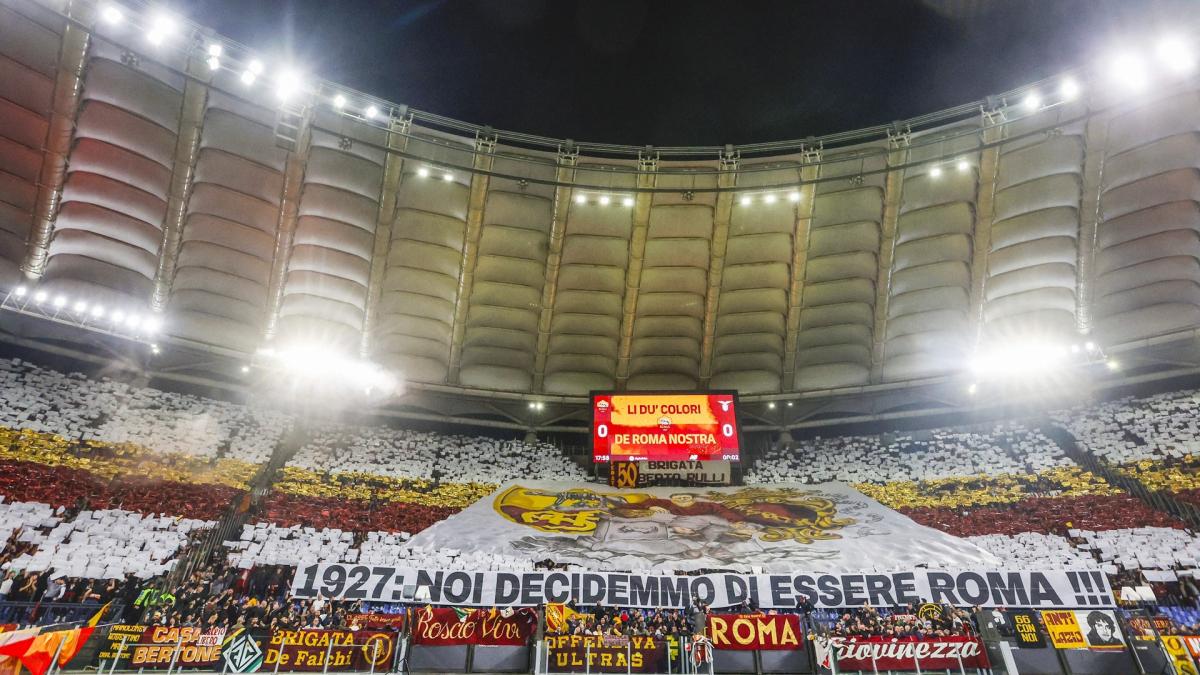
Sunday, September 21 at 12:30 p.m., Rome will live one of the most explosive matches in European football: the derby della capital between Lazio and AS Roma. This meeting, already mythical by the intensity of the sports and political rivalry between the two clubs, is this time placed under a maximum alert by the Italian authorities. The “proof of maturity” of April 13, where 24 police officers were injured and 6 ultras arrested during the previous derby, was “miserably failed”, according to security officials. For several days, the prefecture, the Ministry of the Interior and the police have multiplied meetings and action plans to avoid new clashes that would tarnish the image of the capital and could even weigh on the Italian candidacy for Euro 2032.
As reported La Gazzetta dello Sportthe major risk of this derby lies in the massive arrival of foreign ultra, historical allies of the two Roman stands. On the South Curva side, the Fratelli Giallorossi await the Greeks of Gate 13 (Panathinaikos), the Spanish of Frente Atlético (Atlético de Madrid) and the Croats of Bad Blue Boys (Dinamo Zagreb). Opposite, the North Curva of the Laziali should accommodate equally radical supporters: the Germans of the Lokomotive Leipzig (Ultras and Blue Side Lok), the Polish of the Hooligans of Wisla Cracuvie, the Bulgarians of Sofia West (Levski Sofia) and the English of Inner City Firm (West Ham). These alliances, often built on far -right ideological affinities and consolidated during European trips, make fear scenes of very violent clashes, similar to those of 2015 and April 2024.
The fear of an explosive cocktail of foreign ultra
The recent story of the Roman derby is punctuated by violent episodes and “punitive expeditions” which feed concern. In 2006, Ultras from Roma had burst in the middle of the night in a hotel to attack Greek supporters from Olympiakos, injuring one of them in the thigh, before matching a bus of opposing supporters. More recently, in April 2024, clashes between 300 hooligans from the two camps broke out at 9:30 am, with jets of craft bombs and projectiles on the police. The Poles of Sharks, renowned for their violence, had already come in number in 2015 and had participated in urban riots against the police. These precedents feed the fear of an identical scenario on Sunday, in an extremely tense political and sporting context.
For this derby, the eternal city turns into a fortress. More than 1,500 police officers, riflemen and riot units will be mobilized in the Olimpico sector and throughout northern Rome. From the day before, the surroundings of Foro Italico and the pubs frequented by the ultras are placed under surveillance, while specialized teams carry out the “bonifica”, that is to say the excavation of the bushes, banks of the Tiber and parking lots, in search of weapons, sticks or firecrackers. On match day, air police will deploy helicopters and connected drones directly to the Questura operational room and the stadium GOS room. The axes leading to the Olimpico will be closed from the morning and a specific traffic plan is set up to separate the flow of supporters as much as possible.
The 60,000 spectators expected on Sunday will have to go through a double filtering and pre-filtering system, with door openings from 10 a.m. The approach courses were strictly differentiated: Ponte Milvio for the Laziali, Ponte della Musica and Ponte Duca d'Aosta for the Romanisti. The car parks are also distinct, Villaggio Olimpico for the first and Piazzale Cludio for the latter. ATAC, transport company of the Rome urban area, has reinforced 22 lines of public transport to absorb massive flows. Through this impressive device, Rome hopes to avoid chaos and show its security know-how at UEFA, while the Italian candidacy provides two stages in the capital (Olimpico and Pietralata) for Euro 2032. But each keeps in mind that the slightest major incident could transform this showcase into diplomatic and media fiasco.
