
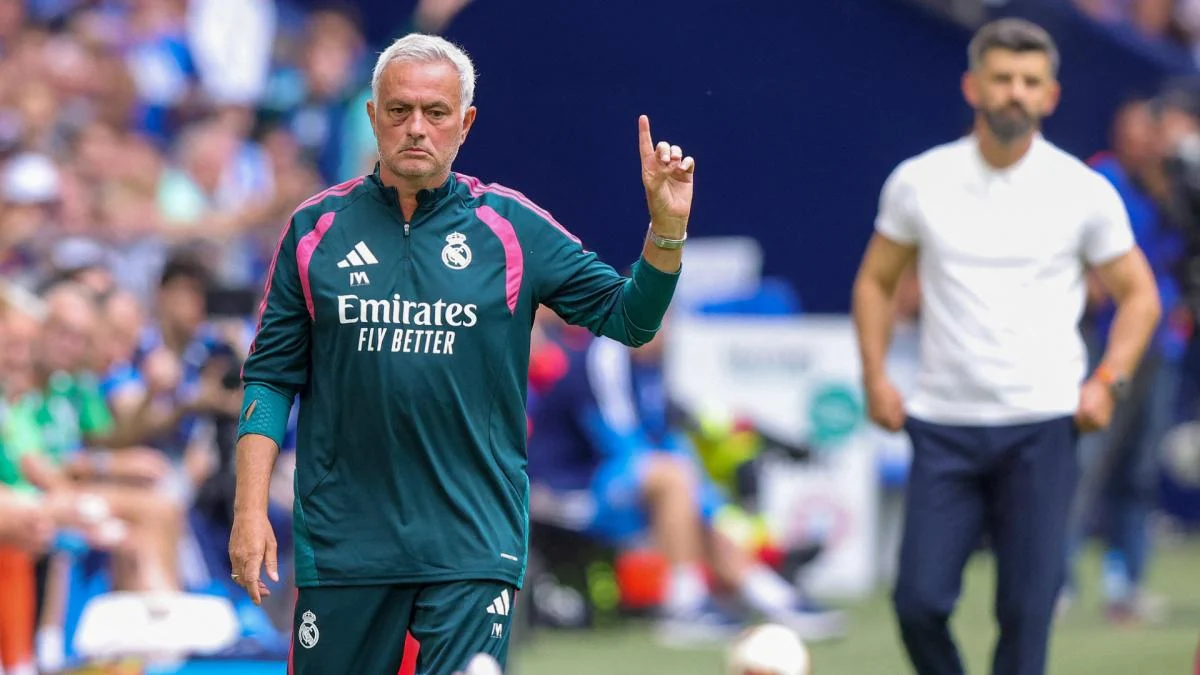
Returning to Real Madrid thirteen years after his departure from the Spanish capital, José Mourinho was responsible for restoring order to the White House. At 63, the Portuguese arrived presenting himself as a new man. Obviously, the age is no longer the same and the Special One has thirteen more years of experience. On the pitch, on the other hand, the new strong man of the Merengues has not really revolutionized the affair. Real Madrid are fourth in the standings and are already six points behind FC Barcelona. In terms of gaming, nothing really new to report. The Merengue collective was shattered in its first major meeting (against Atlético) and the stars of the team have not (yet?) woken up after two blank seasons.
But if Florentino Pérez chose to recall Mourinho, it is because the Lusitanian remains a formidable leader of men, despite not having filled his trophy cabinet enormously in recent years. It is also on this aspect that the program “Bet it drive show: a stroll in Madrid with Yevhen Krazhan” interviewed the Madrid coach. And the latter took the opportunity to provide advice to young players. At a time when life as a footballer in a big club can make many young people lose their minds, Mourinho explains that this job is not to be taken… as a job.
Mourinho pushes his players to break certain rules
“You’re a footballer 24 hours a day. That’s also the problem. You train two or three hours a day, but you’re a footballer 24 hours a day. So everything has an impact on your work: what you eat when you’re not at the club, what you drink, how you sleep, and even certain aspects of your private life. Unfortunately, a footballer cannot ski or cycle. If he does…I don’t care about the contract. What matters to me is the way you approach your work. If you fall off your bike, you risk missing three games, or worse: you could break a leg or suffer a bruise that will prevent you from giving your best. You have a group of friends, you are young, single, you are 22 or 23 years old. Your friends go out clubbing on Wednesday, Thursday and Friday nights, but you can’t go. You can only go out the evening after the match, provided you don’t have another meeting within three days, which can happen. There are a lot of things you have to give up to become a footballer. But, in the end, the career is short. When you reach 35, more or less, there are still many years left to enjoy life differently. But football, deep down, is not a job, it’s a way of life. If you treat it as just a hobby, you’re screwed. If you only think of yourself as a footballer for a few hours a day, you’ll never reach the top.”he confided, before mentioning another important aspect of his management: respect for certain rules.
“There are rules and rules. Some are non-negotiable. And others I love to see players break. Let me explain: if we have to show up at nine o’clock sharp, it’s at nine o’clock for everyone. And if you arrive at 9:15, even if you’re a superstar, that’s just not acceptable. I do not accept, I do not tolerate that this simple rule is broken. But during the match, if a player — through talent, creativity or intuition — breaks the rule and takes the risk of trying something different, that’s OK, it happens to me too. I prepare for the match with my assistants and my analysts. We try to reduce the unpredictability of the game as much as possible. I try to establish a plan: “Okay, it’s going to happen like this. If we lead, I will do this; If we are led, I will do that. » But, once the match starts, I don’t think about the analysts or the assistants. I simply have a hunch and act on it. And if, in the end, the result is not what I hoped for, I don’t blame myself, because I did it for the team. I did it because I felt it was the best thing to do. So, when the rules are broken in this way — say, by taking a little risk in relation to the initial structure or idea — and we act guided by an intuition… we sometimes even have the impression of having received divine inspiration. This has happened to me before. After the match, I start to think about what I did, and when the result is extraordinary, we say to ourselves: “Hey, it was He who pushed me to do it. “That’s why I trust the player on the pitch even more. So, for me, the rules — the non-negotiable rules — are found off the field. On the pitch, you have to break the rules. » The message has gotten through.
