
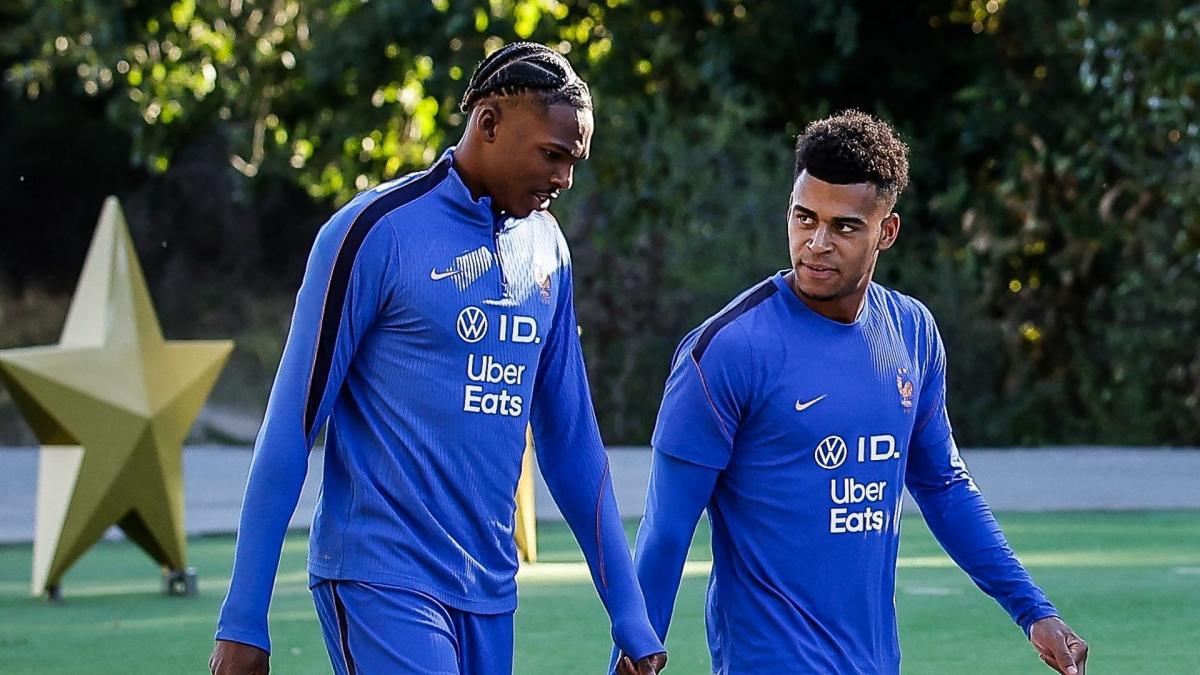
When unveiling her very first list at the head of the Blues, Zinédine Zidane unwittingly offered a nice spotlight to the Stade Rennais trainers. The nod to the Breton club did not stop at Estéban Lepaul since seven other players from this selection had passed through La Piverdière during their training. In addition to regulars Ousmane Dembélé and Désiré Doué, Eduardo Camavinga and Adrien Truffert returned, while Jérémy Jacquet, Lucas Da Cunha and Andy Diouf were called up for the first time in the Blues. Anything but a coincidence.
For decades, Stade Rennais has firmly established itself as one of the highlights of French football. A know-how recognized by the FFF, whose annual study had raised the Breton club to the first rank of French training centers between 2023 and 2025. A ranking determined by five major criteria: professionalization, playing time in the first team, national selections, education, and European representation. After winning this distinction three times in a row, SRFC once again confirmed the quality of its training in 2026, this time by finishing on the third step of the podium behind PSG and Toulouse, and tied with OL.
“When Rennes developed its training center, that is to say in the early 90s, an emblematic figure quickly emerged: Sylvain Wiltord. It all starts from there, it gave the club a form of foundation, legitimacy. At the start of the 2010s, the best young people from the Paris region often signed for Rennesexplained to us in recent months François Rauzy, journalist for Here Armorique and follower of Stade Rennais. There was also someone very competent, Patrick Rampillon, emblematic director of the training center. He spent 38 years at the club before leaving in 2018. He structured everything by also recruiting very good educators and recruiters.» Among them, Pierre-Emmanuel Bourdeau, Romain Ferrier, Jérôme Hiaumet and the historic recruitment manager, Philippe Barraud, today in Nice.
Real know-how in talent detection
Knowing how to find the arguments that will tip the scales, the words that will reassure, and the speech that will convince a family to entrust their child to Rennes rather than to another large center, such as Monaco, OL or PSG, also requires real know-how. For Stade Rennais, the academic framework (nearly 100% success in the BAC each year) and the prospect of playing professionally – often faster than elsewhere – give weight to the speech. “When we recruit a player at 13/14 years old, we plan ahead by trying to imagine if he will be able to step onto the pitch at Roazhon Park at 18/19 years old. This is the hardest part because a lot of parameters come into play: his physique, his morphology, his mentality, his entourage, all that will count in his development. Observations can thus last several months, several years, with of course the threat of being overtaken by other clubs, but that’s the game.explains a former Stade Rennais recruiter, at the origin of the recruitment of several players currently playing in top 5 European clubs.
In recent years, the choice to take a more local approach is also bearing fruit. Eduardo Camavinga, for example, is from Fougères (municipality of Ille-et-Vilaine) while Désiré Doué, born in Angers but adopted by Rennes, joined football school before he was 10 years old. Jérémy Jacquet arrived in Rennes at the age of 13 from FC Joinville in the Paris region, another fertile ground on which Stade Rennais and all the major French clubs have built their network over the years. A former Stade Rennais scout, who has been around the Ile-de-France region for more than 20 years, reveals to us the criteria that guided his recruitment when he officiated in Rennes.
“I personally relied on 4 fundamental points: potential, projection, that is to say: can you see far with this player? You then have performance, which necessarily counts, regardless of age, and which allows you to realize if this player has something extra. Then the personality, for everything that has to do with the mental aspect, the surroundings, his work mentality. In Rennes, the technical criterion is also more important than the athletic characteristics. This is what will make the difference at the high level”he explains. Landry Chauvin, former Rennes recruiter, goes in the same direction: “Doué, Truffert, Da Cunha and Diouf were weaklings when they arrived in Rennes. But we had two main criteria: playing intelligence and the player/ball ratio.he emphasizes in the After.
Upgrading and the constant search to enhance potential
Omnipresent in the youth selections of the French team, Stade Rennais also manages to produce at least one player per generation of European level: Ballon d’Or Ousmane Dembélé among the 1997s, Armand Laurienté among the 98s, Lilian Brassier among the 99s, Sacha Boey, Sofiane Diop, Lorenz Assignon, Wilson Isidor among the 2000s, Lucas Da Cunha, Adrien Truffert, Yann Gboho in the class of 2001, Eduardo Camavinga, Guela Doué, Georginio Rutter among the 2002s, Matthis Abline, Andy Diouf, Loum Tchaouna, Arthur Atta for the 2003s, Djaoui Cissé and Lesley Ugochukwu among the 2004s, the Golden Boy Désiré Doué, Jérémy Jacquet, Mathys Tel and Jeanuël Belocian for the 2005s… Not everyone was promised such a trajectory, but Rennes also has the strength to know how to transform potential into success. In Rennes, we offer young people a collective, but also individual, framework. Everything is methodical, we adapt to each profile. Young people identified at 14/15/16 years old often succeed, and have a linear continuity which takes them to the first team. Disappointments are very rare in recent years», François Rauzy, journalist and Stade Rennais follower, recently explained to us.
Still puny when they arrived at the training center, Lorenz Assignon and Guela Doué, for example, needed more time before hatching. The first now plays in Stuttgart, the second became an Ivorian international and joined Bayer Leverkusen this summer for more than 30 million euros. In this ongoing quest to optimize the potential of its young people, Stade Rennais was also one of the first French clubs to systematize upgrading. To avoid slowing down their progress, the club no longer hesitates to upgrade, or sometimes even double-upgrade, players who are too far ahead of their age category. Eduardo Camavinga was playing in N3 at the age of 16, and this experience contributed to his preparation at the professional level. At La Piverdière, taking young people out of their comfort zone is also part of the method. To confront them with other issues and enrich their palette, the trainers do not hesitate to take the young people into the field. An approach which, beyond versatility, also helps them mature.
Rennes more careful with its young people at the start of the season
If Stade Rennais’ roadmap involves granting playing time to talents from the training center, Breton supporters will have noted that this trend has been less obvious since the start of the season. Against Le Mans, none of the 16 players used by Franck Haise came from the Academy, a first in 24 years.“There are good young people, but between being good in N2 and playing in the top 3 or 4 of Ligue 1 plus the European Cup, there are already a little fewer people. Some still need to move on.”justified Franck Haise for West France in recent weeks, recalling that Rennes had just sold Jérémy Jacquet and Kader Méïté, two talents trained at the club. Sports director Loïc Désiré did not see it as a fixed situation either: “Diallo is not far away, Lomet is regularly in training. Both Nagida and Ait Boudlal had been recruited by the Academy. We could have not loaned Mukiele, Rayan Bamba and Rosier: it’s a choice to develop them with maximum playing time”. The project remains the same: produce players of international caliber and continue, as much as possible, to feed the ranks of the France team.
