
Kylian Mbappé not defending enough? Vinicius Junior either? Since his arrival at Real Madrid, the observation has come up tirelessly in the analyzes and debates around the Merengue club. The French striker is regularly singled out for his involvement deemed insufficient without the ball, particularly when Real Madrid must press high or recover quickly after losing the ball. A criticism which has gradually extended to the entire Madrid offensive sector, where individuals shine more through their qualities with the ball than through their ability to harass opposing defenders for long sequences. However, what if this apparent weakness was not as easy to judge as it seems? Modern football has made pressing an essential tactical weapon, but its physiological and neurological consequences are rarely mentioned when it comes to asking an attacker to run more and more. This is precisely where the analysis of Dr Flavien Baour, MPR doctor and sleep doctor based in Paris, becomes particularly interesting. “There is no doubt that Real Madrid has attackers who are among the best football players in the world, but there is one area where they participate a little less: pressing”he writes. A remark which does not seek to exonerate the Madrid players, but to ask another question. In a sport where the ball travels faster than a player throwing it at full speed, what is really the point of multiplying runs if the opponent’s brain is already capable of anticipating the movement? Pressing has become a tactical obsession, but above all it constitutes a real cognitive aggression for those who have to play under pressure.
Because pressing does not simply consist of running towards an opponent to prevent them from playing. He seeks to reduce his available time, disrupt his perception and provoke a hasty decision. “Pressing works because it attacks three elements of the ball carrier’s nervous system at the same time: the visual collection of space, the choice of action in the player’s cortex, then the motor program which sends the ball”explains Dr. Baour. An approach that allows us to look at the behavior of attackers differently. When an attacking Real Madrid player does not immediately initiate a run towards the carrier, it is therefore not just a question of desire or physical investment. Thinking can also be tactical and neurological. “An attacker who quickly goes up on a defender with the ball forces his gaze to focus on the threat, the mental map of his partners freezes, and the foot executes a less automatic, less precise gesture, often too early, it is less risky to make a clearance in touch, sometimes too late, which will often give an opportunity to score”explains the doctor. In other words, simply increasing the pressure is enough to change the way the opposing brain processes information. And when time is short, the player no longer necessarily chooses the best solution. He often chooses the one that seems safest. This is why pressing can be so effective, but also why it cannot be reduced to a simple question of kilometers covered by attackers.
Vision at the heart of everything
The first mechanism put forward by Dr Baour concerns precisely vision and the way in which a player constructs his perception of space even before receiving the ball. A footballer’s brain doesn’t just look at leather. He must simultaneously observe the movements of his partners, the spaces available, the defenders coming behind him and the solutions likely to disappear in a few fractions of a second. “The fovea, at the very center of the visual field, provides the acuity necessary to stick the ball to the foot. Around, peripheral vision detects movement and masses, with lower resolution »he recalls. A receiving environment must therefore succeed in bringing together several pieces of information. “The center of vision is on leather and the periphery is on races, intervals and pressures. » However, as soon as a player is attacked by an opponent, this ability degrades. “As soon as the chest remains closed facing the passer, back to the play, in a pivot, a large part of this useful field disappears. The player sees what is in front of him and loses what is happening behind him, where the team needs to attack. » High defenses have perfectly integrated this reality and can use body orientation as a signal to accelerate collectively. This is where dry cleaning directly joins medicine. The receiving player doesn’t just face a physical threat. He literally sees part of his environment disappearing from his field of action.
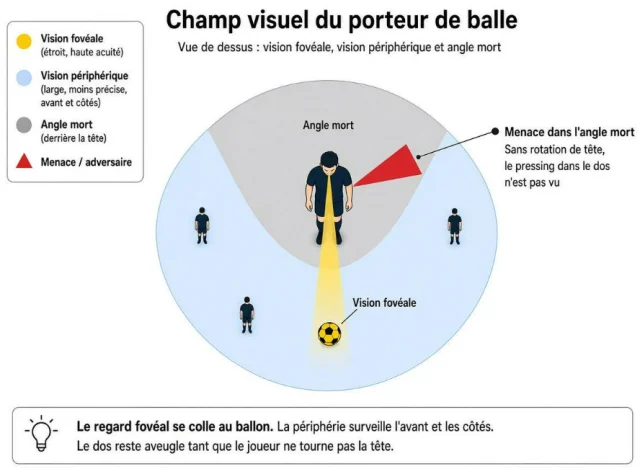
The brain must then constantly reconstruct this map of the terrain, which explains the importance of a phenomenon well known to performance specialists, scanning. “To reconstruct the space before reception, the brain needs repeated visual samples. Scanning, i.e. brief diversions of the head away from the ball, serves precisely this purpose.explains Dr. Baour. Work devoted to Premier League players shows that midfielders and central defenders scan more than attackers and that this frequency decreases when an opponent is very close. “The best midfielders observed make around five to eight scans in the ten seconds preceding the ball. » Under pressure, this work becomes much more complicated since “the nervous system prioritizes the urgent stimulus, ball + defender, and stops updating the mental map of the partners”. The player can then receive with a vision of the field that is already several seconds out of date, which is enough to turn a good situation into a bad decision. Dr Baour summarizes this shift with a particularly telling formula. “Attention closes on the threat. » The brain retains the most urgent information and neglects more distant elements, such as a call behind the back, a free partner or a change of sides. The mechanisms linked to anxiety further reinforce this tendency since attention is focused more on the immediate stimulus than on the solution constructed a few seconds previously. Pressing therefore becomes a battle for time, but also for attention.
A direct role on the brain
This visual overload does not stop at the gaze, however. It ends up having a direct impact on the player’s executive functions, in other words on this part of the brain responsible for processing information, choosing a solution and adapting the gesture to the situation. Receiving under pressure then becomes much more complex than simple oriented control. “Receiving under pressure is at least a double task, but more often a quadruple task”writes Dr Baour. The player must “control the ball + inhibit the primitive response of clearance or driving into contact + update the position of the partners in working memory + choose an option”. A succession of operations which must nevertheless be carried out in a few moments. Inhibition prevents the player from immediately hitting the ball or getting rid of the danger, working memory allows him to maintain a representation of the position of his partners and cognitive flexibility must allow him to abandon the initial plan to find a new solution. “These three functions weigh mainly on the prefrontal cortex”specifies the doctor. When the time available becomes too short, the brain ends up favoring the least expensive option. “When the available time drops below a few hundred milliseconds, the system switches to the least expensive option: back pass / long ball / loss of ball. » This is why a successful press can cause an error without even directly causing a recovery. The simple act of forcing the opposing brain to make an urgent decision is sometimes enough to obtain the desired result.
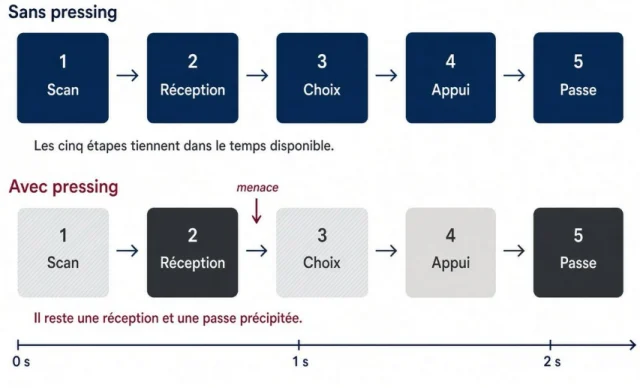
The last element put forward by Dr Baour allows us to understand why this pressure can then spread to an entire team and why the consequences of pressure are not always visible in the first duel. Even when a passing line exists, the technical gesture itself can lose quality. “For the trained player, a fifteen meter pass is largely automated”he explains, comparing this operation to that of a bicycle once the learning has been acquired. But under threat, this normally automatic gesture can be disrupted. “Some of the attention shifts to the impending duel, so fewer resources remain to calibrate the trajectory. Another part of the attention returns to the gesture itself: the player regains conscious control of a movement which should be managed by the reptilian brain. » Result, “the limb gains stiffness and loses finesse”. And the most interesting thing is that the error does not stop at the first player in a hurry. “The worst: these errors are transmitted from one player to another”says Dr. Baour. Premier League passing analysis reported by The Athletic shows that after a bad throw, the next player has 19% less time on the ball and gains 31% less distance towards the opposing goal. “The pressure spreads from one brain to the other. The first was seen badly, the second already received too late, with less space and a poorer engine program. » Since Jürgen Klopp’s great teams and the generalization of counter-pressing, this approach has taken on a considerable place in European football. But it also allows us to take a different look at the Real Madrid attackers. Perhaps the question is not only why Kylian Mbappé, Vinicius or their partners are not pressing enough. Perhaps we also need to understand what their own pressing asks of the opponent’s brain and why, in certain situations, the most useful run is not necessarily the one that the statistics or the spectator’s gaze immediately identify.
