
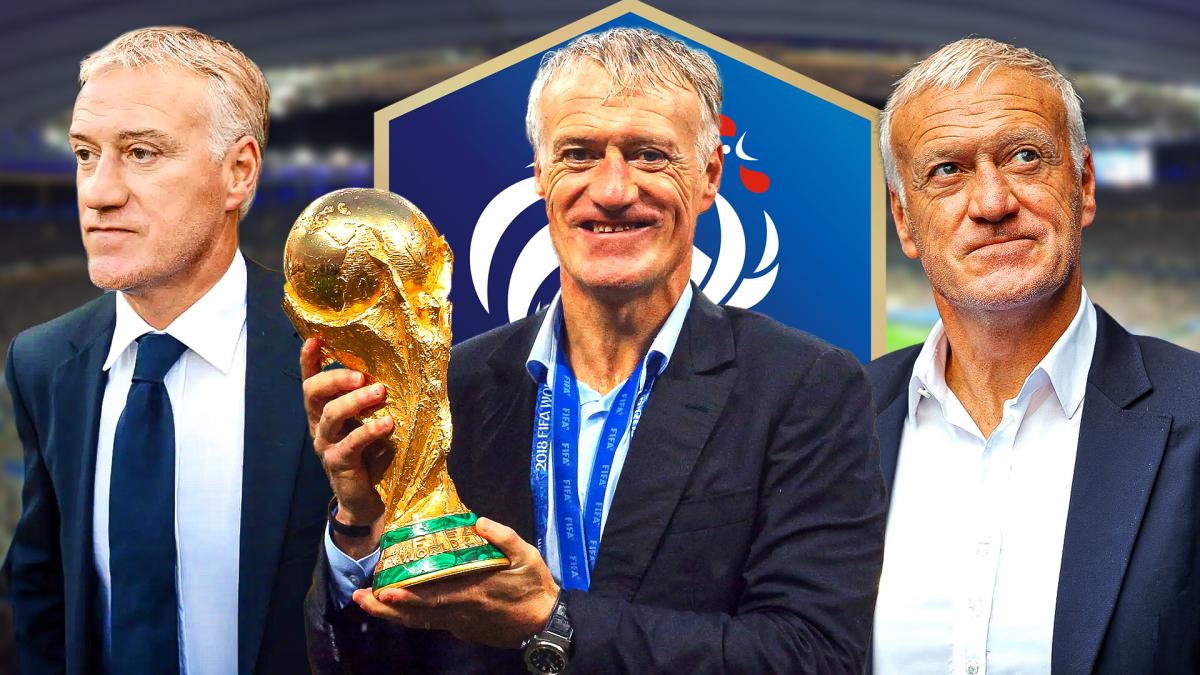
This time it’s over. Didier Deschamps led his last match at the head of the France team. An adventure of more than fourteen years which now belongs to history, with an ending which did not resemble the dream scenario. Eliminated in the semi-finals of the 2026 World Cup by Spain, the Blues then ended their tournament with a scathing defeat against England (4-6) in the match for third place. An outing necessarily less brilliant than the image left by previous years, but which should not in itself sum up an entire era. In a few days, the official arrival of Zinédine Zidane on the French bench should be announced, symbol of an immense transition and a handover almost written for a long time. French football therefore definitively closes the Deschamps chapter to open that of another legend. However, as is often the case with sporting monuments, certain questions sometimes seem difficult to ask. When a man has won so much, when he brought home a World Cup and put the Blues back at the top of the football world, the slightest criticism can quickly be perceived as a form of ingratitude. But legends are not untouchable. On the contrary, their grandeur allows for discussions worthy of their legacy. Didier Deschamps will remain a major figure in the history of the France team, but that does not prevent us from wondering if this immense period could have been even more exceptional. Do we have the right to be frustrated by Didier Deschamps’ 14 years? The question is not an attack on the man, but simply a questioning of the possible gap between an exceptional generation, a historic reign and a record which could perhaps have been even more imposing.
A beautiful epic of 14 years
For many, the answer is a resounding no. And there are extremely strong arguments to defend this position. For fourteen years, France has established itself as one of the major powers in world football. A World Cup won in 2018, a world final contested in 2022, a Euro final in 2016, a Nations League raised in 2021, without forgetting an almost permanent presence in the last rounds of major competitions. This regularity is anything but banal, and historical nations would give enormously to display such continuity. French fans have become accustomed to seeing their team reach the semi-finals, finals or the most prestigious decisive matches. This apparent normality is in reality a statistical anomaly. International football is ruthless, and an exceptional generation can disappear in a few years. A victorious dynamic can suddenly collapse. The France of Deschamps nevertheless withstood almost all the storms. It has gone through the years remaining a permanent threat to the biggest teams on the planet.
You also need to remember where you started. Today, the French team appears to be a solid and respected institution. This was not the case when it arrived in the hands of Didier Deschamps. After the Domenech years and a White period which had not completely restored the lost prestige, the Blues had to rebuild their credibility. The former OM coach re-established a hierarchy, imposed collective discipline, restored a competitive identity to a group which was sorely lacking, while rebuilding a relationship with supporters and the media. Little by little, France regained its giant status, and opponents once again feared the Blues. Major meetings were no longer synonymous with predicted disaster, but with assumed ambition. This stability is often underestimated because it has lasted for a long time. However, you only need to look at Germany, Brazil or Italy to understand how fragile the summit is. Glorious cycles never last forever and crises arrive without warning. Great nations can go from being a world favorite to a team in permanent reconstruction in just a few years. As such, Didier Deschamps offered France a rare luxury, that of being able to dream in almost every competition.
A bitter taste of frustration?
But the answer can also be yes. Because behind this extraordinary consistency lies a reality which fuels the frustration of some observers. Ultimately, the record in major trophies comes down to a single conquest, the 2018 World Cup. An immense, historic and indisputable achievement for a group as endearing as it is overpowering. However, when we measure the potential of the generations led by Deschamps, some may legitimately consider that the total seems surprisingly low. The Nations League remains an official title, but it looks more like an addition to the list of achievements than a trophy capable of competing with a Euro or a World Cup. Several major occasions also left a bitter taste. The defeat against Switzerland at Euro 2021 remains a sporting trauma as France seemed superior on paper. Euro 2024 has also fueled criticism with often laborious play and a persistent impression of untapped potential. Even some brilliant qualifying never quite erased the feeling that this team could offer more than what they ultimately produced.
The comparison becomes even more piquant when we look at what has happened elsewhere. Over the last twenty years, an Italy plunged into a deep crisis has won two major trophies with the 2006 World Cup then Euro 2021. The comparison obviously has its limits as the Italians have also experienced historic humiliations and resounding absences which would not naturally make any French supporter jealous. But she reminds us that football retains titles above all. Spain had time to dominate the world, collapse then return to the top with a new Euro in 2024 and this 2026 World Cup. Lionel Scaloni’s Argentina, with two Copa América and a World Cup, accumulated trophies in a much shorter period of time. Luis de la Fuente’s Spain also built an impressive record very quickly. And this is where the frustration arises. Not because Deschamps would have failed. It would be absurd, but because some believe that with Mbappé, Griezmann, Pogba, Lloris, Kanté, Varane, Dembélé, Benzema, Giroud and many others who followed up to the generation of Olise, Tchouaméni and Upamecano, France undoubtedly possessed the richest raw material in world football. From then on, the question becomes inevitable. Is a single World Cup an accurate reflection of the potential of this generation or the minimum they had to achieve?
