
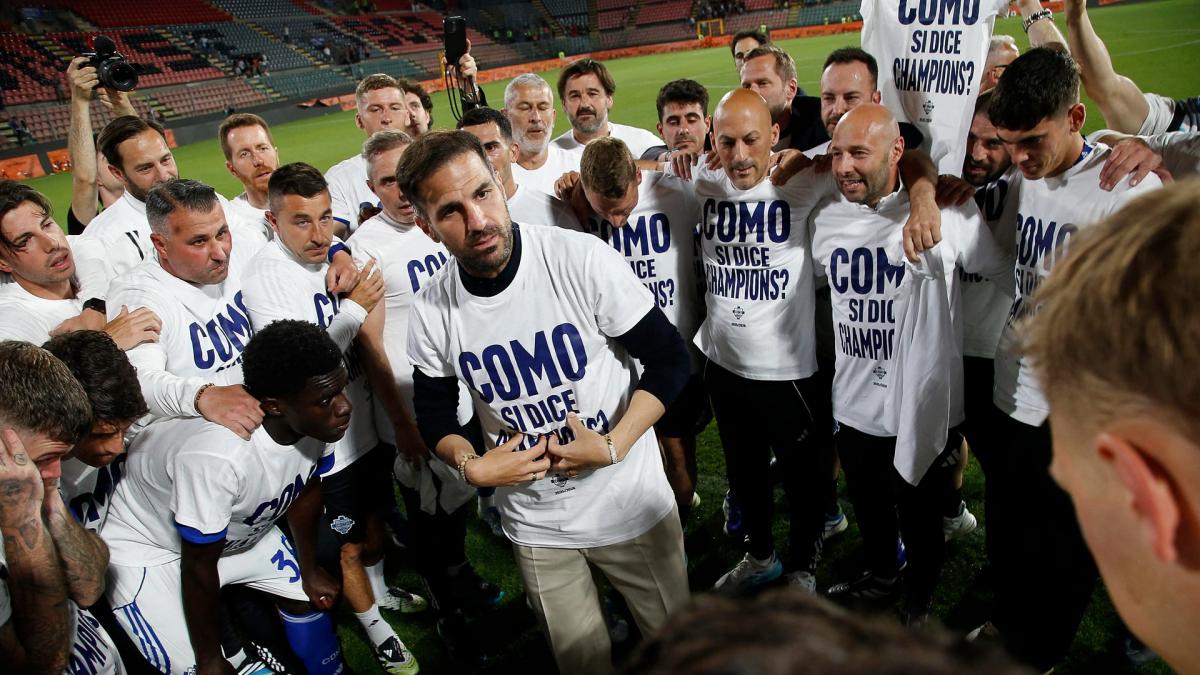
Como’s qualification for the next Champions League resembles those stories that football loves to sell to the whole world to convince itself that it remains romantic. Four years ago, the Lombard club was tinkering in Serie D with infrastructures unworthy of a European contender. Today, he invites himself to the giants’ table after finishing ahead of AC Milan and Juventus. The scene is almost too perfect to be true. An entire city in a trance in Piazza Alessandro Volta, blue and white smoke bombs at the edge of the lake, scooters honking until the early hours and a 39-year-old coach transformed into a modern prophet of Italian football. All this with a team built at high speed thanks to Indonesian owners with almost limitless means, capable of establishing a provincial club in a completely new dimension in a few seasons. In a calcio accustomed to austerity plans, aging stadiums and presidents who talk more often about debts than football, seeing Como emerge as a billionaire start-up has something unreal. And inevitably, in the middle of this lightning rise, there is Cesc Fàbregas. Always him. The face of the project, the voice of the project, the idea of the project. The one who recently said that he had his players massage in a bar for lack of a training center worthy of the name. The one who convinced an entire town that it could dream bigger than its postcard setting. Fàbregas must also be given immense merit. Many would have used the financial power of the club to build a cynical team, calibrated to survive with aging stars and the project was heading more or less towards this path if we remember the arrivals of Sergi Roberto, Raphaël Varane, Pepe Reina, Andrea Belotti and Dele Alli.
But the former Barça and Arsenal midfielder has established a clear and coherent identity. A team that monopolizes the ball, presses high, multiplies rotations and assumes considerable risks when restarting. The automatic comparisons with Pep Guardiola have sometimes turned into a caricature contest as soon as a former Barça player completes three short passes in his own half. Como don’t play like Manchester City and don’t even really try to. Fàbregas’ project looks more like a more vertical, more defensive and more aggressive version of Roberto De Zerbi’s principles. A lot of possession, yes, but above all a lot of direct play after fixing the opposing pressure. The goalkeeper attracts, the central players dare, the midfielders constantly swap and everything is designed to create superiority in free space rather than to put the opponent to sleep with a thousand lateral passes. The result was terribly effective with the best defense in the championship. Como stifled a good part of Serie A thanks to its counter-pressing and its ability to recover the ball very quickly. But we also have to put certain things in their place. Behind the fiery speeches on the tactical revolution of Lake Como, the spectacle was not always as flamboyant as announced. This team controls a lot, but sometimes produces repetitive, mechanical, almost academic football in certain offensive sequences. The effectiveness is indisputable. Poetry often depends on the camera angle chosen.
A worthy project, but…
And this is precisely where the real subject begins. Because the story is magnificent for Como, but it can become worrying for Italian football. For years, Serie A has clung to its European performances to maintain the illusion of a championship that has become powerful again. The recent successes of Inter Milan, AS Roma, Fiorentina and Atalanta had helped mask enormous structural problems. This season, everything fell apart almost simultaneously. Italian clubs sank far too early in the Champions League, Europa League and Europa Conference League. The national team remains traumatized by the absence at three consecutive World Cups with this new fiasco against Bosnia last March. Young Italian players are leaving the country earlier and earlier or stagnating in environments incapable of developing them properly in the Italian antechambers. And meanwhile, the two economic locomotives of Italian football, AC Milan and Juve, will watch the Champions League from their sofa while Como enters the competition with a squad where the Italians are almost invisible. The irony is brutal since the club which today represents the revival of calcio, which attracts all the spotlight, embodies precisely everything that calcio no longer really produces. Few locally trained players, very few young Italians, an identity more international than national and a huge dependence on massive foreign funding. For the romantic image, it’s great. For the health of Italian football, the question deserves to be asked.
The most difficult part begins now and recent Europe is full of examples which should calm the excitement. To stay in the Boot, Bologna discovered the violence of returning to reality after its explosion under Thiago Motta. Stade Brestois already knows that confirming an exploit is often more complicated than achieving it. Girona also understood that a brilliant project can quickly become vulnerable once dissected by the whole of Europe since they have just suffered a terrible relegation. And the shadow of Leicester City in the Premier League still hangs over this type of modern tale. Como has ideas, money and an extremely intelligent coach. But the club remains very far from the structural standards of a real regular in the Champions League. The Sinigaglia Stadium still needs to be modernized to meet UEFA requirements. The training center does not yet resemble that of a large continental club. The squad completely lacks experience at European level and UEFA rules on locally trained players already expose certain limits of the project. To appear on the UEFA lists, at least eight players out of the 25 registered must have played three full seasons in Serie A between the ages of 15 and 21. Among them, at least four must come from the training center. To date, only two Como players meet these conditions: goalkeeper Mauro Vigorito (35 years old) and defender Edoardo Goldaniga (32 years old). Behind the glamorous window of the lake and the billionaire investors, many foundations remain fragile. It is no coincidence that the Mapei Stadium in Sassuolo has already been designated as a backup solution. Even when celebrating, Como still walks on crutches.
Shining in Serie A with an army of young talents on loan from Spain is already a remarkable feat. But the real challenge begins now for Como. Because in Italian football that is weakened sportingly and economically, qualification for the Champions League cannot simply become a glamorous interlude before a brutal return to reality. Calcio no longer needs pretty ephemeral displays. It needs clubs capable of existing sustainably at the highest European level to modernize the entire ecosystem. Côme impressed with his ideas, his audacity and his ability to promote gems like Nico Paz. But bringing out talents often belonging to other European powers will not be enough forever to build a true continental stature. A failed European campaign with a simple round trip in the league phase would quickly turn the fairy tale into a stark reminder of the structural limits of the project. And in the current state of Italian football, that would be a particularly cruel symbol. Como fully deserves his qualification and no one can seriously take that away from him. But this success also acts as a cruel mirror for Serie A. If a club without recent European tradition, without fully ready infrastructure, without a real Italian base and with a project built in accelerated fashion can overtake Milan or Juventus so quickly, then the problem goes far beyond the success of Fàbregas. Italian football is going through a deep crisis that even its beautiful stories can no longer hide. Como symbolizes as much an exploit as a warning. The calcio today celebrates a historic qualification on the edge of the lake. Tomorrow he may have to ask himself why his giants left so much space for a newcomer to come and take away their light.
