
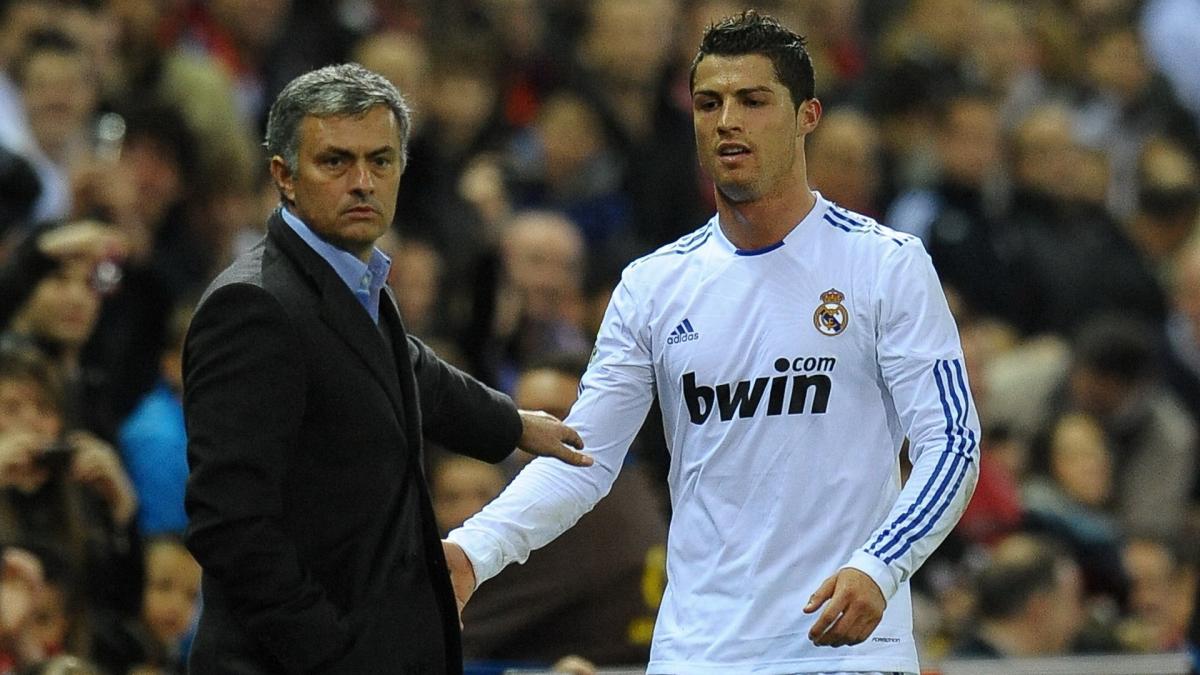
For some, the Messiah has returned to the holy lands. For others, it is simply the ancient serpent which reappears at Valdebebas and at the Santiago Bernabéu. It must be said that the choice to bring back José Mourinho clearly divides Madrid. Strong choice of Florentino Pérez, the Special One is indeed far from being unanimous among Madridistas. It is a question of his recent sporting failures, he who is considered by some as a coach on the downward slope, far from having the tactical genius of his years at Porto or Inter. Others, however, believe that the strong character of the Portuguese is exactly what the Real Madrid locker room needs, which showed all the colors to Xabi Alonso then to Alvaro Arbeloa, while a divide has also been created between the players and the public.
Arriving in 2010 in a very complicated context in Madrid – dominated by Pep Guardiola’s FC Barcelona and ridiculed on the European scene for years – the Portuguese very quickly crystallized tensions. His adventure had not necessarily started badly, and we saw a Mourinho who was certainly determined, intense and competitive, but far from being that of the years to come. Everything changed one evening in November 2010, for his first Clasico in La Liga. Led by a Lionel Messi of great evenings, FC Barcelona had simply rolled over the Merengues (5-0), in what is considered one of the biggest humiliations in the history of football. A traumatic manita for José Mourinho. Aware that he was going to have great difficulty controlling the gang of Xavi and Iniesta on a tactical or technical level, he switched to the dark side of the force.
Exacerbated anti-Barcelonism
From then on, we saw a much more aggressive José Mourinho, at all levels, being the main instigator of a rivalry which reached heights of hatred in the early 2010s. The Portuguese increased the number of media outings criticizing FC Barcelona, evoking in particular referees according to him favorable to the Catalans, a Liga and a pro-Barça UEFA and media won over to the cause of the Barcelonans. Fuel to the fire, clearly, and the supporters and players of Real Madrid have clearly joined the cause of the Special One. After the defeat in the semi-final of the Champions League in 2011 against the Blaugrana, for example, he was the author of a major tirade against the referees with this famous “Por Que?” » (“why” in Spanish, Editor’s note) in which he questioned the decisions of numerous referees who would have favored Barça in previous years and which still often comes out as a even on social networks. There is no doubt that he would have enjoyed this Negreira affair now.
A sulphurous first season, but during which the almost conspiracy theories and the accusations of José Mourinho against Barça found support among the Madrid public. It must be said that with this Laiga-Champions League double for Barça, many madridistas preferred to rely on Mourinho’s words to justify and minimize the titles of the sworn enemy. Little by little, however, the general Spanish public began to get annoyed. Many feared tensions between the Barça and Real Madrid players in the selection, and Mourinho did nothing to ease all that, quite the contrary. The episode of the Spanish Super Cup in the summer of 2011 – during which he put his finger in the eye of Tito Vilanova (then in Guardiola’s staff) during a scuffle – was a highlight of his adventure in Madrid, and it was from that moment that he began to be hated by many beyond the Pyrenees.
A Real Madrid divided like never before
Enough to strengthen Mou in his posture of “everyone is against us, everyone wants us harm”. Only problem, little by little, Mourinho also began to divide Real Madrid supporters. Particularly because of tensions with several highly regarded players, such as Sergio Ramos, Cristiano Ronaldo and especially Iker Casillas. The latter had notably been put on the bench for the benefit of Diego Lopez, in a soap opera which had fascinated the whole of Spain. The Portuguese’s management created a lot of wear and tear among the players, and there was real permanent tension in the locker room. Clans were also created in the locker room, and all this led to a huge division within the supporters and the media, creating the biggest crisis in the club’s history on a social level. On one side, the pro-Mourinho, on the other, the anti-Mourinho. A divide which went well beyond the common interest of the club, and which remained anchored in memories. The pro-Mourinho were particularly violent in the debates with their interlocutors, to the point where some media even spoke of “jihad mourinhista”.
Many supporters are afraid to see such a clash again in the fanbase, and on top of that, many are convinced that his methods are a little outdated and that his management could not work with the current locker room. However, not everything has been negative, far from it. If he failed three times on the European scene, not winning this long-awaited Décima, his Real Madrid started to scare again in Europe, with 3 qualifications in the semi-finals in 3 seasons, where the Merengues always stopped in the eighth or quarters for a good while already. His 4-2-3-1 allowed Real Madrid to regain a competitive spirit that it had lost, and we must necessarily mention this 2011/2012 Liga, during which the Merengues were crowned champions of Spain by reaching 100 points. A very vertical game, destructive for his opponents, and players who have reached an excellent level on an individual level under his command. Many believe that he laid the foundations for the Champions League won in 2014, during the first season without him. Suffice to say that it will be exciting to see how José Mourinho will adapt to this locker room…
