
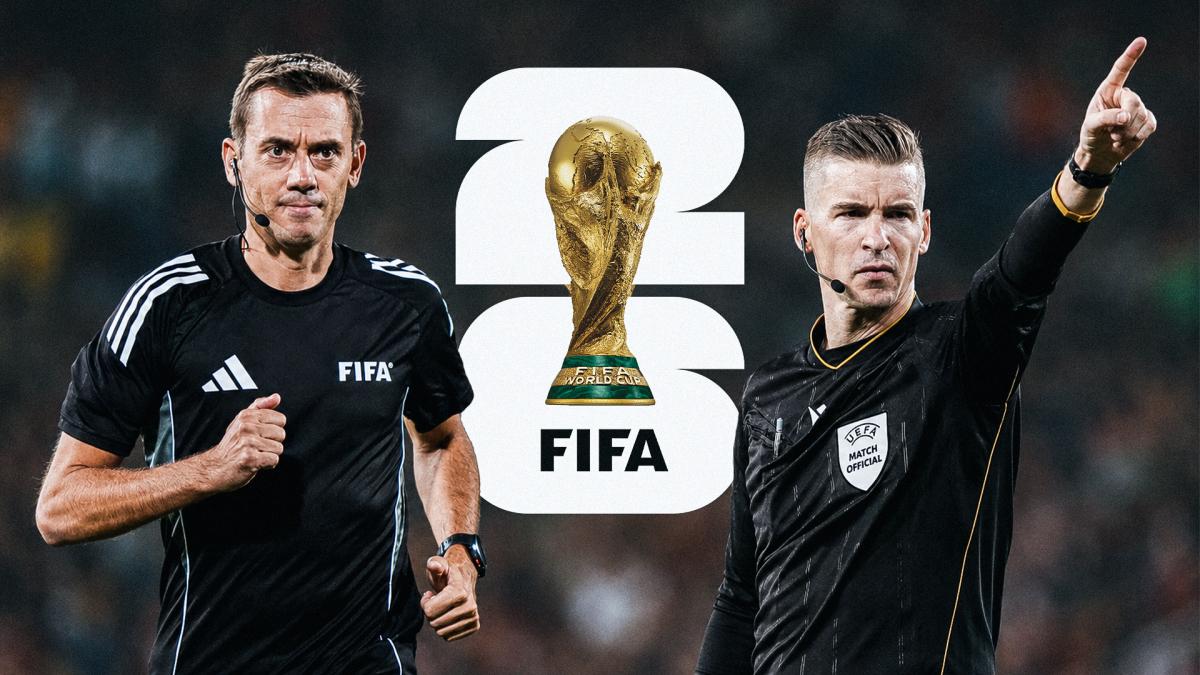
With just over a month to go before the 2026 World Cup, the apparent calm of the Clairefontaine National Football Center contrasts with the excitement that already surrounds the biggest meeting in world football. Here, however, there is no question of the stars expected in the United States, nor of the lists of selectors or the tactical systems. In the video rooms, on the training grounds or during long debriefing sessions, another preparation takes place, more discreet but just as essential: that of the French referees who will represent France during the World Cup. Because in a football where every decision can change a match, the men in black, now equipped with microphones, earpieces and screens will be more than ever at the heart of the game. The French delegation will advance with an experienced face who is now essential on the international scene. Clément Turpin, a European reference for several seasons, and François Letexier, whose meteoric rise has been confirmed in recent months, will officiate as central referees during this 2026 World Cup.
Alongside them, their assistants will complete a particularly extensive French system, while Willy Delajod and Jérôme Brisard will have a key role in the VAR coaches, which have become essential in the modern ecosystem of arbitration. With new technologies, the harmonization of FIFA instructions and the desire for increased transparency with the sound of VAR decisions, French refereeing is approaching this World Cup with an immense responsibility to enforce the rules in a football that is ever faster, more exposed and more contested. One month before the 2026 World Cup, preparation is intensifying for the referees selected by FIFA. Meeting in Clairefontaine before their departure for the United States, François Letexier and Clément Turpin are refining the final details of a competition which goes far beyond the simple technical framework. Because a World Cup is not only prepared on the pitch: emotional management, adaptation to the new FIFA instructions, cohesion between referees from all over the world or even work on the new protocols linked to playing time and VAR will be at the heart of the preliminary training organized by the world body.
A great first for François Letexier
For Letexier, who will discover a World Cup for the first time, the event represents a huge leap into another dimension. “The pressures are different. A performance that we would be required to accomplish, we would take a long time to recover from if we did not succeed. In volume and quantity, it is different. The pressure will be high and it will have to be controlled. I will discuss these subjects with Clément. If I can save time by using his advice, I will. Recommendations from FIFA? We are scheduled to arrive in the USA on May 31. These ten days will serve to prepare us physically and technically. We will have sessions of 2 to 4 hours for classic themes but also on non-sporting topics including racism. There has been a change in the appearance of the game. There are several new rules and a certain number of modifications to manage effective playing time and in particular time savings. Fortunately, there will be anticipation“, explained Letexier. Beyond the purely regulatory aspect, FIFA also wants to create a common base between the 52 referees selected for the competition.
In a tournament where every decision will be dissected on a global scale, harmonization of interpretations and mental toughness become essential. The referees will live together for several weeks, between training, video analyzes and permanent evaluations. “In a more structured competition, it is easier to have strict rules. Mental preparation is the result of long work, an increase in skills and experience in the face of controversy. Every controversy, I learned something positive from it to come out stronger. We will try with my assistants to keep the pleasure of refereeing a World Cup at the heart of our process. Nothing can happen to us if we keep this pleasure and this luck. We have to focus on ourselves. We all want to make the final, but in the end, there will only be one left. We must therefore not think about the appointment or performance of the colleague. I am not the master of designations or performance ratings. We must control what we can. We don’t yet know the starting phases, but there will be waves. This is not established in advance. There will be skimming in the middle of the competition. From 52 referees, we will go to 40. We start a competition without knowing when it will end. Relations are very good between all the referees. Obviously, you can get along better with one group than others. But nothing harms our professional relationship despite common objectives», he adds.
A collective experience but also an internal competition, since the designations will evolve throughout the tournament with progressive eliminations among the officials. In this logic of global standardization, the FIFA seminars will also aim to standardize referee readings on the most sensitive situations: hands, management of protests, time savings or VAR interventions. Meticulous work to minimize differences in interpretation between continents and refereeing cultures. “FIFA pays attention to consistency and harmonization. These ten days will serve as a reminder in a large general brainstorming with several situations and cases presented. We can trust FIFA that the rule applied is the same. I have no uncertainty about the technical line expected and defended by FIFA. There may be errors of interpretation. But on the FIFA line is clear and homogeneous. We will not withdraw the media debate“.
The world reference Clément Turpin
Already present during previous major international competitions, Clément Turpin will approach this new 2026 World Cup with a very different status, the third for him like Joël Quiniou in the past. Respected on the European scene, a regular at major events and now a major figure in world arbitration, the Frenchman will be one of the executives of the FIFA group. But behind the accumulated experience, the challenge remains immense by living for more than a month in isolation, far from the family, within a cosmopolitan group where human cohesion counts as much as performance on the field. “It was something unattainable when I started in my sector in Saône et Loire. We don’t even dream of it. Professional arbitration in France began in 2016. As experiences progress, we say “and why not”. Record equalized? I don’t chase records. The day after qualifying, I called Joël, I wanted to share this moment with him as a transition. We spent 30 minutes on the phone. What is special is the time we will stay there. We’re gone for at least 5 and a half weeks. There are things to put in place. We move away from the family. After ten days, we will have a little drop because we will miss the family. The World Cup is a long marathon. We’ll see where it takes us. With François? We’re not just going to call each other. We will be on the same site. All our training sessions, our meals… We have an excellent relationship between our two teams. It is a French team of 8 referees. The eight of us really like each other. Jérôme’s role will be key. The video referee is at the heart of arbitration today“.
Within the FIFA base camp, the referees will alternate physical sessions, ball training, video analysis and practical workshops on the new laws of the game. A total immersion that Turpin considers to be one of the major benefits of a World Cup. “This is the most positive side: living with lots of international referees from different cultures. The first ten days will be important. The idea is to create a group spirit. We are team one. We will alternate training times with players. We will familiarize ourselves with the new regulations. We are going to repeat the scales. We are also putting things into practice to standardize decisions. We will all have to take the measure together. The World Cup has no equal. Then the competition begins and there, it’s special and it becomes a real anthill between those who recover, those who analyze their matches, those who prepare for their next match. We live with Asians, South Americans… We discover people with different cultures and histories. Staying in a French bubble would be a huge mistake. There will be more than 150 people between the principals, the assistants, the VARs. On a human level, it’s great but also on a refereeing level. By opening up to others, we discover different trade-offs“.
At almost 44 years old, Turpin undoubtedly approaches this meeting with an additional form of perspective. More peaceful, more experienced too, the French referee wants to take full advantage of the event without letting himself be overwhelmed by the stakes or the extreme emotions imposed by a global competition. “I want this World Cup to be the World Cup of wisdom. There will be moments of joy and moments of doubt. But I don’t want my emotions to spiral out of control. I want to experience this World Cup with serenity. I want to experience it with emotions but also with moderation and tranquility. The age of reason as they say. There has to be fun. Everyone dreams of being part of a competition like this. Let’s enjoy a breakfast with African colleagues, a technical exchange with Asian colleagues», concluded Turpin. far from the spotlight focused on the stars of football, French referees are also moving towards their World Cup. In an increasingly fast, technological and exposed football, François Letexier and Clément Turpin know that in the heart of the tumult of the 2026 World Cup, each whistle will count as much as a goal.
