
There is something profoundly dizzying about watching the fall of Chelsea today. As the defeats pile up, the coaches parade and the projects collapse before even having existed, the London club seems trapped in a cycle from which it can no longer escape. The lightning spell of Liam Rosenior, crushed in barely a hundred days after a historic black series, is only the latest symptom of a much deeper evil. For a decade, Stamford Bridge has become an electric bench where ideas, ambitions and sometimes even reputations are consumed. From Thomas Tuchel to Graham Potter, from Frank Lampard to Mauricio Pochettino, to Enzo Maresca, none has really survived this chronic instability. Even the most promising passages have dissolved into a permanent emergency, as if the club, once a winning machine, was now incapable of building anything other than the short term. The figures themselves tell of this drift, a succession of increasingly short mandates, a blurred identity, and a team today stuck far from its standards, on the edge of European places.
And in this modern chaos, a name resurfaces with an almost dreamlike force, like a memory that resists time. That of Roberto Di Matteo. A name that belongs to another era, or perhaps to an enchanted parenthesis that contemporary football can no longer reproduce. In the image circulating today, he appears only tenth in the ranking of Chelsea coaches in terms of points ratio in the Premier League, stuck between more established figures, but still ahead of several recent technicians swept away by the current storm. A modest position in terms of history, and yet fraught with an immense paradox. Because none of his successors have managed to recreate what he accomplished in just a few weeks. At a time when Chelsea are desperately seeking stability, the memory of this temporary worker who became king of Europe returns to haunt the present, like a question left unanswered.
A career with a question mark
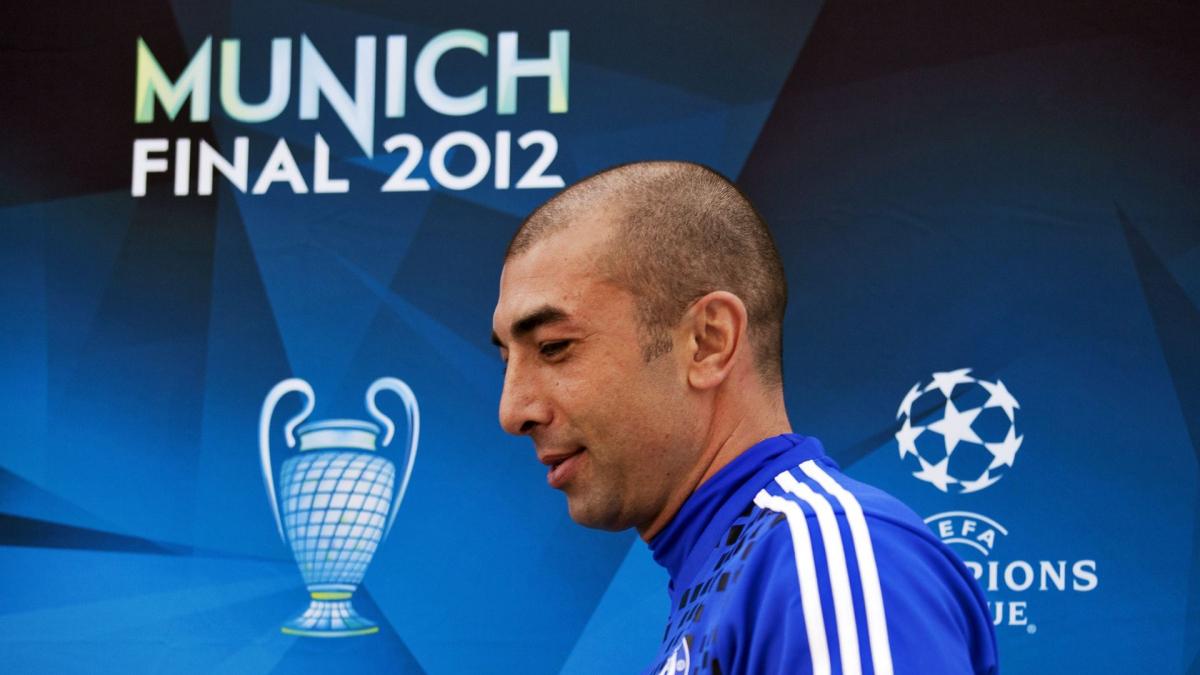
When Roberto Di Matteo took the reins of Chelsea in March, he was just a man passing through, a deputy thrust into chaos after the fall of André Villas-Boas. Nothing then predestined it to enter history other than as a temporary solution. And yet, in the space of a few weeks suspended out of time, he transformed an aging and fractured team into a team capable of overthrowing Europe. There is this unreal evening against FC Barcelona, this miracle at Allianz Arena against Bayern Munich, and this trophy that no one expected. A Champions League won with pain and self-sacrifice, a few weeks after an FA Cup won at Wembley. Football sometimes has its anomalies, and Di Matteo is one of the finest. But this enchanted parenthesis closes as quickly as it opened. A few months later, despite a decent start to the season, the former Lazio player was abruptly dismissed. As if even the greatest feat in the club’s history was not enough to slow down the relentless mechanics of Stamford Bridge.
When he passed away in the fall of 2012, carried away despite his European coronation, Chelsea entered another era without really knowing it. An era of chronic instability, where names follow one another without ever registering. Behind him marches Rafael Benítez, then the return of José Mourinho, the passages of Antonio Conte and Maurizio Sarri, before the modern spiral accelerates further with Frank Lampard, Thomas Tuchel, Graham Potter, Mauricio Pochettino or Enzo Maresca. An almost dizzying succession, where even successes become provisional, where even a Champions League won by Tuchel was not enough to stabilize the project. For ten years, the club has multiplied short cycles, contradictory visions and unfinished reconstructions, with an accumulation of technicians who often only had a few months to exist. In this tumult, the mark left by Di Matteo becomes unreal. He has only managed a few dozen matches, but he remains the man of the club’s first European coronation, the one who transformed a team out of breath into European champion in just a few weeks. As if, since his departure, Chelsea had never stopped searching without ever finding this suspended moment.
And then there is Di Matteo’s personal trajectory, almost a mirror of this unique moment. After touching the summit, it moves away silently. A brief stint at Schalke 04, an aborted attempt at Aston Villa, and then silence. Where others would have capitalized, multiplied the benches or maintained their aura, he gradually disappears from the landscape, as if he refused to trivialize what he had experienced. Even a duty firefighter status in Serie A like other Italian tacticians will never tempt him. His coaching career ends there, frozen in this spring of 2012 which has become untouchable, even if a few rumors will emerge including Las Palmas. Years later, the native of Schaffhausen reappears in bits, on the sidelines of the game, in roles of advisor or ambassador, notably back at Chelsea, where everything changed, but also in the South Korean club Jeonbuk Hyundai Motors in 2023 for a few months. And when he still speaks, it is with a form of distance, almost with melancholic lucidity. In an interview given to theAFP this week at a football festival in Hong Kong, Di Matteo explained that he was ” vital “ for the club to find a balance and add experience to a workforce that is too young, insisting on the need for a “good balance” to hope for regularity. A simple and obvious sentence, but which resonates today like an echo from another time. The one where Chelsea won without necessarily understanding how, but with a form of invisible consistency that, since then, no one has really been able to recreate. What if, in the midst of this permanent disorder, the club’s greatest success had also been its most ephemeral…
