
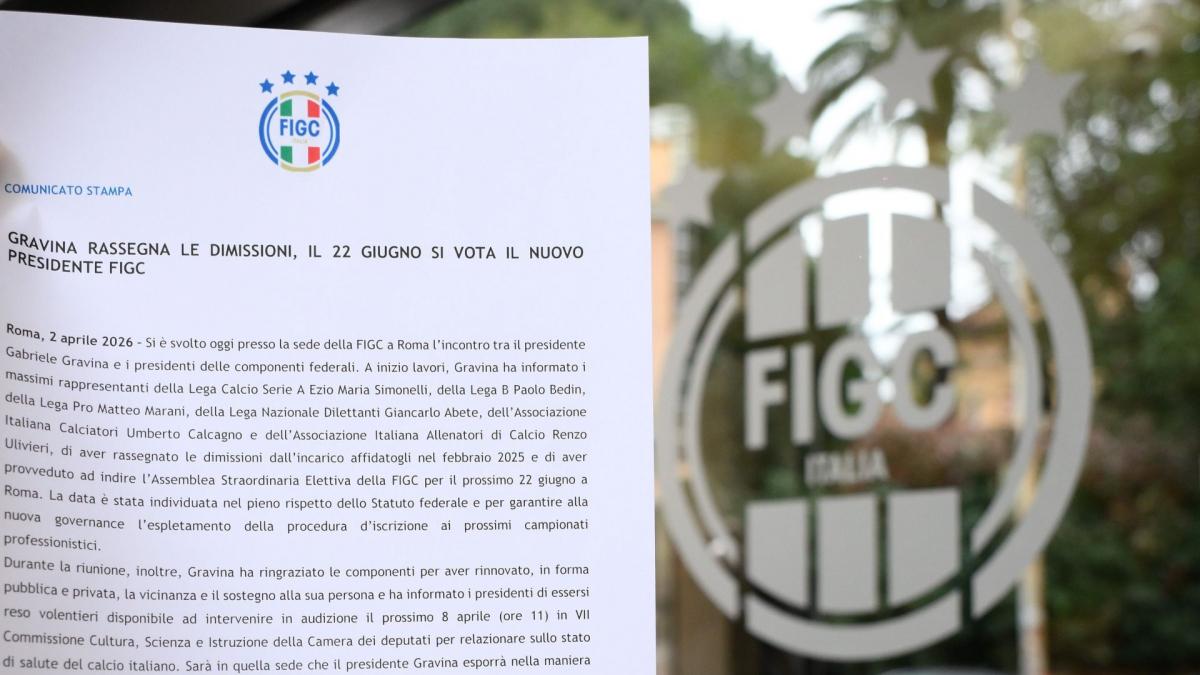
Italian football woke up groggy, but determined to get back up. The elimination against Bosnia plunged Italy into new trauma by depriving it of a third consecutive participation in the World Cup. A historic humiliation for a quadruple world champion nation which immediately triggered an institutional earthquake. The president of the Italian Federation, Gabriele Gravina, left his position immediately, quickly followed by coach Gennaro Gattuso and head of delegation Gianluigi Buffon. The time has now come for reconstruction and eyes are turning towards the presidential election scheduled for June 22. Several figures are already positioning themselves to embody the renewal, first and foremost Giovanni Malagò, the big favorite supported by some of the clubs. Others imagine a more symbolic solution with a former icon of the game, like Paolo Maldini or Alessandro Del Piero, in order to reconnect the federation with the historical DNA of calcio.
But the reconstruction of Italian football will not only be played out in the offices of the federation or on the bench of the Nazionale. It will also go through a profound transformation of Serie A which is currently struggling to rejuvenate its football, whether tactically, technically, or even medially. Despite more than positive results in the Champions League, the Europa League and the Europa Conference League in recent years, the Italian championship remains criticized for its lack of attractiveness and its inability to produce new offensive talents capable of competing with global phenomena. Comparisons with the new stars of European football have become recurrent. Italy does not have Kylian Mbappé or Lamine Yamal and this absence symbolizes a deeper structural problem, especially since the young selections are doing well at the Euro and World Cup. Former players, coaches and political leaders are increasing their analyzes and calls for reform to save a football that is adrift. They all share the same observation. The Italian system has gradually become locked into habits which slow down the training of young talents and favor a growing dependence on foreign players.
Finally a place left for young people?
The figures illustrate this spectacular transformation, and the Gazzetta dello Sport draws a glaring assessment this Tuesday morning. The share of foreign players in Serie A has continued to increase in recent years, from 55.2% in the 2017-2018 season to almost 69.1% in 2025-2026. Only the Premier League does more with 75.4%, while the Portuguese Liga reaches 73.8% in an assumed role as a training and exporting championship. Behind Italy, Ligue 1 peaks at 64.9%, the Bundesliga at 61.4% and La Liga remains much more attached to its national players with only 43.4%. This trend is even observed in the reserve teams. The second teams of clubs like Inter Milan, Atalanta and Juventus already use a significant proportion of foreign players in the lower divisions, a sign that the phenomenon extends to the entire pyramid of Italian football. Behind this development lies an administrative problem rarely discussed outside Italy. The financial compensation system imposed by the federation makes transfers between Italian clubs much more complex and costly than operations with foreign clubs. As a result, managers often favor the international market to the detriment of developing local talent. Faced with this observation, a real revolution is now under study.
2026 World Cup: how Italy fell so low

Bosnia
1–1

Italy
The president of the Lega Serie A, Ezio Maria Simonelli, is campaigning to fundamentally reform this mechanism in order to revive the domestic market. The idea is to simplify the financial guarantees required for transfers between Italian clubs or to create a state-backed guarantee system, possibly through the Institute for Sports and Cultural Credit. The project is being discussed with the Minister of Sports, Andrea Abodi, and could be accompanied by tax incentives intended for clubs which develop players likely to join the national team. Behind these economic reforms lies a broader strategic objective. The football elite intend to ask the government for tax breaks, public aid to invest in sports infrastructure, and unity to challenge the EU rule which prohibits the recruitment of players under 16 years old. The development of a policy to support the development of young people is indeed essential. An Italy competitive on the international scene would also benefit clubs by promoting their players and strengthening the overall image of the championship. In this collective slump where many teams now belong to foreign investors, calcio leaders know that the equation is simple. Reforming Serie A has become essential to restore a future to Italian football and offer the Nazionale the talents it has sorely lacked in recent years.
