
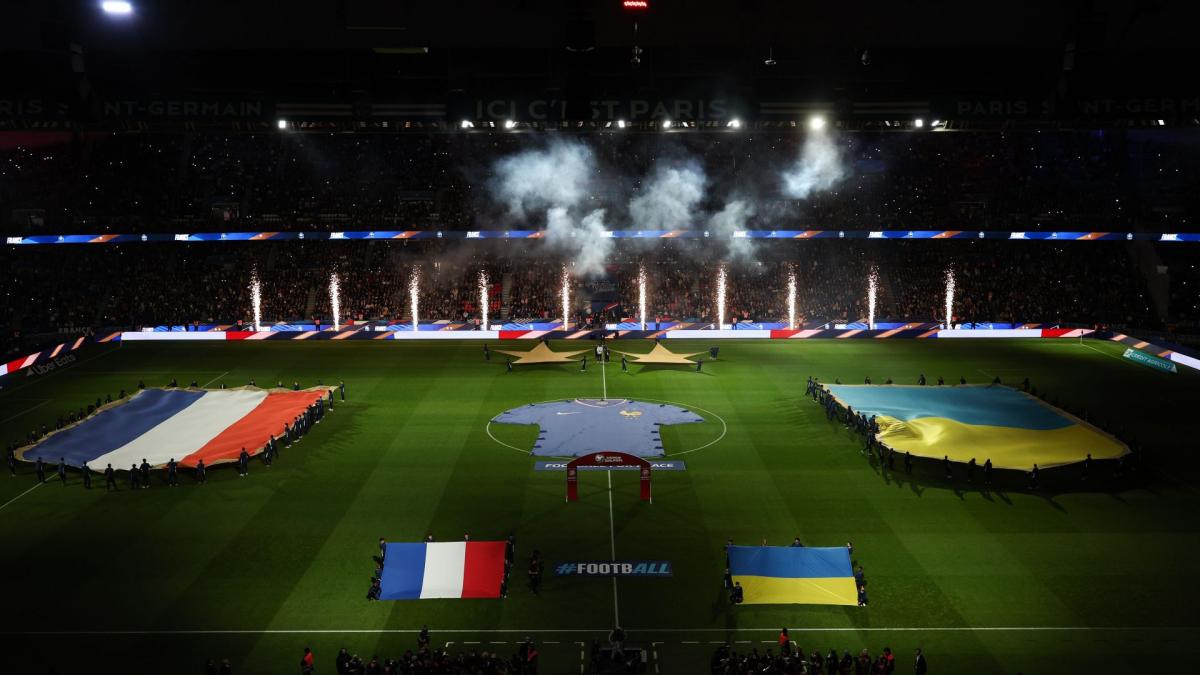
Ten years to the day after the night of horror of November 13, 2015, France found a football stadium full of memory. This Thursday evening, the Blues face Ukraine at the Parc des Princes, as part of qualifying for the 2026 World Cup. A seemingly banal match on a sporting level, but eminently symbolic. The coincidence of the calendar, or rather that of international authorities, placed this meeting on a date marked forever in the national memory. On November 13, 2015, France faced Germany at the Stade de France when the first explosions rang out in a series of attacks that would plunge the country into shock and mourning. Ten years later, the faces have changed, but the scars remain. This France-Ukraine is therefore being fought in a particular climate, marked by contemplation and respect, where every minute before kick-off resonated with a historical echo.
Since the morning, tribute ceremonies have followed one another in the capital. Emmanuel Macron began the “journey of remembrance” at the Stade de France, where three suicide bombers blew themselves up near the stadium. Surrounded by families of victims and associations, the Head of State laid a wreath of flowers before observing a minute of silence. In the process, the official processions reached the terraces of the 10th and 11th arrondissement where Le Carillon, Le Petit Cambodge, La Bonne Bière, La Belle Équipe, La Cosa Nostra are located, so many places now symbols of a battered France. Finally, the day ended at the Bataclan, scene of the bloodiest drama, where 90 spectators were murdered. In meditation, the city of Paris paid tribute to its children, with sobriety and dignity. A frozen, silent capital, before turning, in the evening, towards the Parc des Princes, for a final moment of unity.
A solemn tribute orchestrated by the FFF at the Parc des Princes
The French Football Federation had prepared a sober ceremony, full of emotion. Before kick-off, the 45,000 spectators at the Parc des Princes stood up for a minute of silence, observed in an almost religious silence. On the lawn, a huge “Football for Peace” tarpaulin (“Football for peace” in French, editor’s note) covered the central circle, while the players wore the Bleuet de France on their jerseys, a symbol of memory and solidarity. In the stands, François Hollande, Bernard Cazeneuve, Salim Toorabally, the security guard who had repelled one of the terrorists at the Stade de France, as well as representatives of the police, firefighters and victims’ associations, took their places alongside the public. The FFF had also set up a collection of donations for the benefit of Bleuet de France, as well as a symbolic race in tribute to the victims. The message was clear. Beyond football, it was about remembering together, remembering that life, music and sport remain the most beautiful acts of resistance.
A few minutes after a beautiful Marseillaise echoed in chorus by the entire Parc des Princes and a minute of silence perfectly respected by the supporters present, the four stands of the Parisian enclosure deployed a huge tifo in unison, in the 13th minute as a symbol: “To our 132 stars of November 13”, followed by a song “Daesh we fuck you”. And when the match started, it was not a match like any other. In the chants of the public, in the looks of the players, in the applause of the Park, we felt this seriousness mixed with hope. Emotion dominated, stronger than the sporting issue. Didier Deschamps, Kylian Mbappé and their teammates know that they represent much more than a team. These 11 Blues carry this evening the memory of a country bruised, but standing. Football has regained its noblest meaning, namely that of a link, a symbol, a shared memory. Ten years later, France has not forgotten.
