
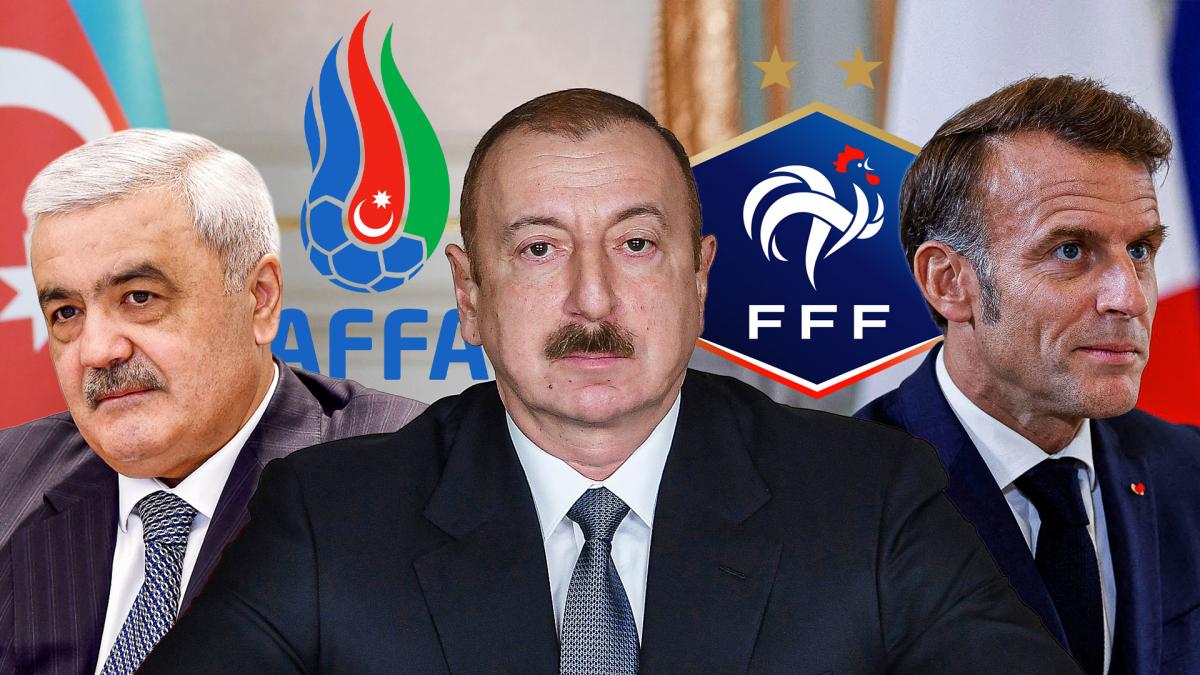
Friday evening, the Parc des Princes will regain its tricolor coat. Under the spotlights adorned with anthems and flags, the Blues will welcome Azerbaijan for the third day of the 2026 World Cup qualifiers. On paper, it is a match well within the reach of Didier Deschamps' men. On the ground, Mbappé, Maignan and others are aiming for new success to ensure a smooth road to the United States, Mexico and Canada. But beyond football, this meeting hides another confrontation, much more subdued: the one between Paris and Baku. Because if we are talking about a sporting opposition, this football match is also, symbolically, the extension of a diplomatic and informational standoff which has lasted for several years between the Élysée and the Presidential Palace of Zagulba.
However, everything started well between the two nations. France was one of the very first countries to recognize the independence of Azerbaijan, in December 1991, a few months after the fall of the USSR. The following year, an embassy was established in Baku and official visits multiplied. In 2004, newly elected President Ilham Aliyev chose France for his first visit abroad. At the time, Paris saw this small Caucasian state as a promising partner, rich in hydrocarbons, and eager to open up to the West. For years, cooperation has intensified: economic exchanges, academic collaborations, and even sustained cultural dialogue. France, a member of the OSCE Minsk Group, then took on the role of arbitrator between Armenia and Azerbaijan in the Nagorno-Karabakh conflict. Everything seemed to be going in the right direction. Until diplomacy also finds itself at the heart of a duel without a referee.
A diplomatic standoff
The break took place against the backdrop of war. In 2020, Baku won a resounding victory against Yerevan in the second Nagorno-Karabakh war, reconquering almost all of this disputed territory. For France, marked by a strong Armenian diaspora and committed to the defense of minorities, the defeat of Yerevan resonates painfully. Emmanuel Macron then increased his criticism against Azerbaijan, while Paris signed a military cooperation agreement with Armenia. In Baku, this development is experienced as a betrayal. France, once the arbiter, takes sides. From then on, the tone hardened. In Ilham Aliyev's mind, Paris becomes the voice of the “Hostile West”, in his words. The diplomatic terrain is transformed into a battlefield. And soon, the blows no longer come in speeches, but in the digital shadows. In July 2023, the French service Viginum, responsible for the fight against foreign manipulation, spotted a vast disinformation campaign called “Olympia”. The objective was to damage France's reputation in the run-up to the Paris 2024 Olympic Games. Thousands of fake accounts spread mocking messages, questioning the country's ability to organize the event and calling for a boycott under the hashtags #Paris2024 and #BoycottParis2024. Investigators trace the trail to an account linked to a member of the New Azerbaijan Party, in power in Baku. A few months later, again, with a new campaign claiming that an invasion of bedbugs is ravaging Paris.
The images are reproduced all over the world, sowing panic and tarnishing the image of the country a few months before the Games. The DGSI will later speak of a “interference and destabilization attack», orchestrated in part from Azerbaijan, sometimes with the help of Moscow. Football has nothing to do with it, but France discovers that its evening opponent knows how to score goals… in the field of information warfare. Baku does not stop at fake news. In July 2023, during a conference of the Non-Aligned Movement, Azerbaijan created the Baku Initiative Group. This collective brings together independence activists from French overseas territories, including New Caledonia, Martinique, Guadeloupe, under a virulent anti-colonial discourse. The message is then to accuse France of perpetuating an imperialist policy. Since then, Azerbaijani flags have appeared in pro-independence processions in New Caledonia, portraits of Aliyev have been circulating, and Azeri state media have published inflammatory columns accusing Paris of “cause bloodshed“. For the French authorities, this is an operation “massive and coordinated» of interference. This geopolitical front has reignited all the tensions between the arrests of French nationals in Baku, the cross-expulsions of diplomats, and, more recently, the assassination in France of an Azeri political opponent. A freezing climate, which makes the context of Friday's match as tense as a penalty shootout.
A football nevertheless in development
Azerbaijan, however, wants to show another face. Under the presidency of Rovshan Najaf, the Association of Football Federations of Azerbaijan (AFFA) is multiplying projects with the establishment of VAR, opening of an academy in Tovuz, hosting of the FIFA Series in 2024. Gianni Infantino, President of FIFA, welcomed the efforts of a country engaged in “the development of football» For Baku, it is also a way of improving its international image, of appearing as a modern and sporting state: “ We appreciate all its programs, all its initiatives, which is why we are committed to participating more in FIFA's activities and programs. We are of course very happy with what is happening in Azerbaijan, but FIFA must work hand in hand with the many countries, the many nations that make it up to further develop football, increase its inclusiveness, make it accessible to those who want to play and watch football.“, said Rovshan Najaf. But in Paris, this diplomatic veneer fools no one. The Aliyev regime knows that sport, like gas, is a weapon of influence. This match against the Blues is therefore a symbolic opportunity to prove that we exist on the world stage, even if it is for a kick-off.
So yes, Friday there will be football. Dribbling, stopping, shouting, anthems. But there will also be meaningful looks between officials, symbols to be interpreted, and a context that goes far beyond the simple competition. Between France and Azerbaijan, everything is no longer a question of quiet diplomacy. It's a game with several sides, where every gesture counts: an interview, a press release, a post on X… or a match at the Parc des Princes. And if the Blues want to stick to sport, their opponent will see much more. This match will take the form of a world stage where we play our place not only in Group D, but in the great geopolitical chess game of the 21st century.
