
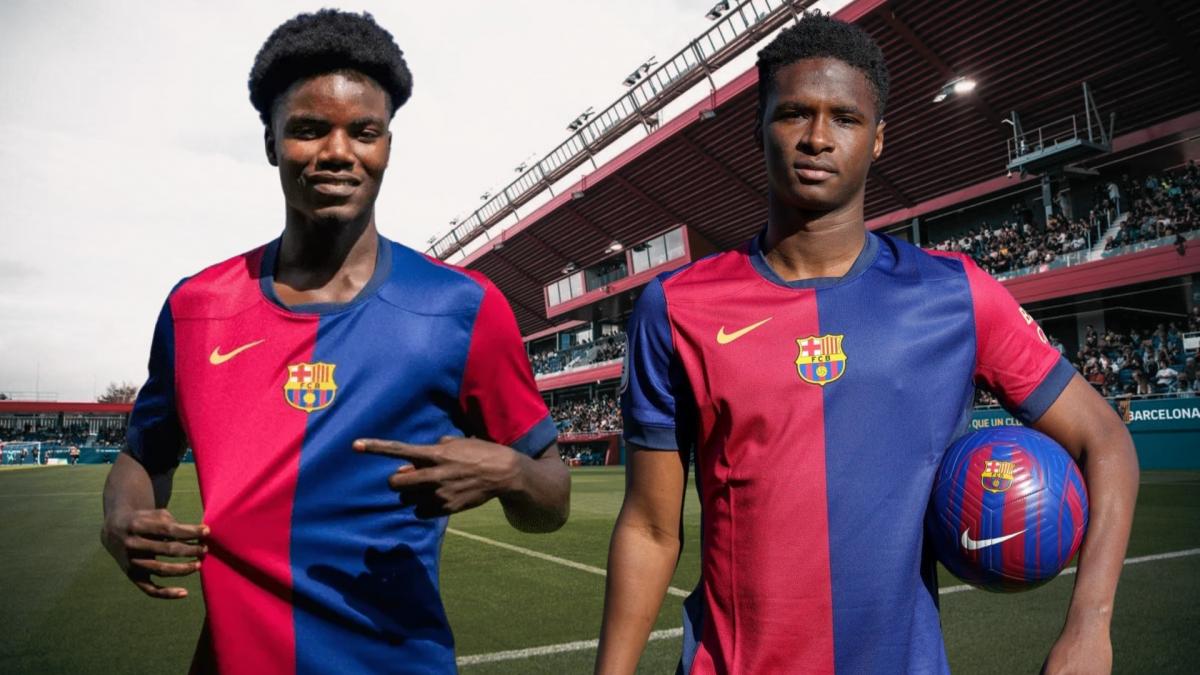
When it comes to filling the ranks of the Masia, FC Barcelona is used to doing its market in Catalonia or Spain, thanks to a recruitment network which allows the Catalan giant not to miss any young talent emerging in the clubs of the region and in those of the rest of the country. A perfectly woven spider web which has never really pushed the leaders of the training center to go digging internationally. There have been a few exceptions, necessarily, like a certain Lionel Messi, or some young Brazilians who arrived in sometimes a little shady operations involving agents close to the club like André Cury, but overall, Barça has always been satisfied with the regional and national vivier.
Africa, where many French and English clubs are used to seeking the talents of tomorrow, has often been neglected by Barça. In the 2000s, the presence of Samuel Eto'o had facilitated the arrival of certain young Cameroonians at the Masia via the attacker's foundation, but it was rather episodic and only guards André Onana and Fabrice Ondoa managed to make a career in the elite. It was thus very rare to see young Africans play with the U15s, the U17s, the U19s or Barça Atlètic (Barça B, Editor's note), since the teams were mainly composed of Spanish players, and the few Africans who passed there were binationals born or having grown in Spain, like Abde Ez (Morocco) or Ilaix Moriba (Guinée). On the other hand, in recent times, many players from the African continent have set their suitcase on the side of the Barcelona academy.
Affordable players in times of crisis
This is the case of the Senegalese Mika Faye, already left on the side of Rennes, or his compatriot Mamadou Mbacke, who evolves with Barça Atlètic in Spanish D3. Last summer, the Catalans also went to the accra leons in Ghana to recruit the lateral David Oduro, just as they also enlisted his compatriot Abdul Aziz Issah of the Dreams FC. Both also play with Barça team B, while Hafiz Gariba, a young Ghanaian central defender also arrived last summer, plays with the U19. Then, this winter, Barça recruited Ibrahim Diarra, considered one of the biggest African talents, and arrived from the Africa Foot academy in Mali. Many young people also do test sessions to see if they have the capacity to reach Barça once they have celebrated their 18th birthday. Other young people such as Amara Diouf (16, Senegal, Generation Foot) or Mofuchile Mofuchile (20, South Africa, Orlando Pirates) are also on the shopping-list of Barça and could arrive in Barcelona soon, while there are a dozen African players in the various U15 teams in Barça.
Why this sudden interest in young African players? There is an obvious sporting response. In recent years, the level of infrastructure and training in many sub -Saharan African countries has soaked, and the Gap that separates African players from European players has relatively reduced. Young soccer players trained in their country are now capable of being efficient once you arrive in Catalonia and Europe in general, and they often bring different things that are missing among young Europeans, especially on the physical level. The club also improved its network in Africa, with the arrival of Moussa Koné in the recruitment cell in 2023. It is he who is behind all these arrivals, and who also concluded partnerships with several important academies in different African countries. So far, Barça has been content to follow international competitions to follow the evolution of possibly interesting players; From now on, the club wants to have the nuggets on the continent on hand from an early age and prevent other European clubs from taking it before them. And the financial risk in the event of failure is less, contrary to what happened with Vitor Roque for example.
A sports and financial strategy
It is a project perfectly assumed by Barça, which therefore intends to work in the long term in Africa. Behind all this, there is also a financial reality. Young African players are generally much cheaper than their European or South American colleagues. It is not just a question of level, not at all the same, but African players are simply less rated, just like African clubs or academies are much less powerful financially and cannot afford to refuse approaches to Barça. It is much easier for FC Barcelona, a club in financial difficulty, to seek a young hope in Mali or Senegal rather than in Argentina, Brazil, Germany or Portugal. And precisely, the affordable price of these players allows Barça to envisage a trading strategy which can be particularly interesting. Recruited for 1.5 million euros in Croatian D2 (but he was already followed when he was in Diambars), Mika Faye was sold 10 million euros a year later. So a beautiful added value, and Barça hopes to repeat this kind of operation in the future.
The best players will be gradually promoted until possibly reaching the first team, which is far from being impossible in this Barça where young players often have a chance. Ibrahim Diarra is also considered by observers as a player with the potential to find a place in the workforce of Hansi Flick – or the next Barça coach – in the medium term. In search of the new Sadio Mané or the next Samuel Eto'o, Barça could also launch a fashion in Spain. On the side of Real Madrid, Africa is clearly neglected and South America is purified, where Juni Calafat is like a fish in the water and has already brought players from the caliber of Fede Valverde. Likewise for the other big clubs in the country, such as Atlético or Villarreal. Valladolid is one of the rare clubs who built networks there, having thus welcomed a very young Mohammed salisu, today in Monaco, or Juma Bah, recently sold at City Group. Anyway, Barça believes as iron in its new African project, and the next few years will tell us if the Catalans will have been right or not to turn to the cradle of humanity …
